Check What a £20 Casino Deposit Really Gets You
 Available in US
A £20 minimum sets the amount needed to fund an account, but does not establish how long the balance lasts or whether an offer applies.
How a £20 Deposit Fits the UK Minimum-Deposit Range
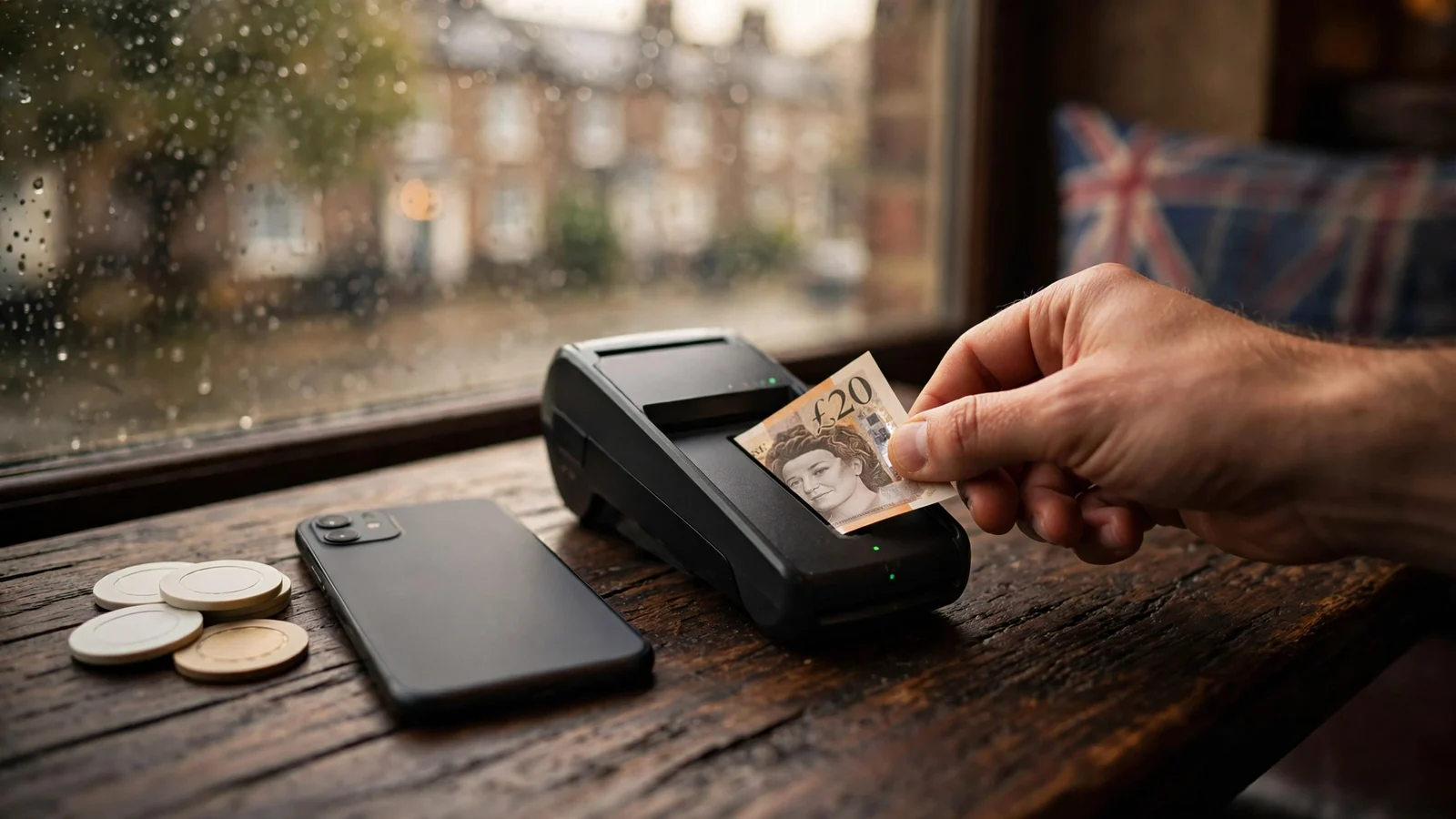
A £20 cashier minimum sits above the lowest entry points reported at UK casinos, but it is not outside the range of published deposit thresholds. Some casinos accept deposits from £1. A specialist review recorded six UK Gambling Commission-licensed casinos with a genuine £1 minimum, although that count describes the review’s findings rather than a permanent market total. Deposit limits can change, so the figure is best treated as a dated snapshot, not a guarantee that six such options remain available.
The difference between a £1 minimum and a £20 minimum is straightforward: the amount required to put money into an account. It does not, by itself, establish how much play that balance will fund, whether an offer applies, or whether the site is suitable. Those are separate questions. For comparing entry thresholds, the useful point is that £20 is higher than the lowest recorded minimums, while still matching a threshold some operators set for customers using direct banking.
If you are looking for a UK casino with a £20 minimum deposit, check the deposit terms before signing up. The details below note the payout speed available for each listed operator.
-
Britsino
- Payout speed
- 1-3 business days
Britsino lists a payout speed of 1–3 business days.
-
Amunbet
- Payout speed
- 1-3 business days
Amunbet lists a payout speed of 1–3 business days.
-
Dieselwin
- Payout speed
- 1-3 business days
Dieselwin lists a payout speed of 1–3 business days.
-
BeOnBet
- Payout speed
- 1-3 business days
BeOnBet lists a payout speed of 1–3 business days.
-
Jetsetspins
- Payout speed
- 1-3 business days
Jetsetspins lists a payout speed of 1–3 business days.
-
SpinFormula
- Payout speed
- 1-3 business days
SpinFormula lists a payout speed of 1–3 business days.
-
Revery Play
- Payout speed
- 1-3 business days
Revery Play lists a payout speed of 1–3 business days.
-
WinBeast
- Payout speed
- 1-3 business days
WinBeast lists a payout speed of 1–3 business days.
-
Chanze
- Payout speed
- 1-3 business days
Chanze lists a payout speed of 1–3 business days.
-
Zombillion
- Payout speed
- 1-3 business days
Zombillion lists a payout speed of 1–3 business days.
A specialist review placed the typical minimum at casinos accepting direct banking at £10, while noting that individual operators set it at either £5 or £20. This is a reported pattern, not a rule that every casino follows. A £20 minimum therefore marks the upper end of the specific range described in that review. It should not be read as evidence that the casino is more exclusive, safer, or better value; the number tells only how much must be deposited to meet that cashier threshold.
The label “minimum deposit” can also be easy to misread. It describes the smallest amount the cashier will accept for a transaction under the stated conditions. It does not mean that every customer must deposit that amount on every occasion, nor does it say anything about the amount required to qualify for a particular promotion. The headline threshold and the terms attached to other account features are distinct. A £20 minimum is a cash-entry condition, not a general measure of the account.
For a comparison, the relevant distinction is between a low entry threshold and a higher one. At a £1-minimum casino, the stated entry requirement is lower; at a £20-minimum casino, more money is needed before a deposit can be completed. The difference is £19. That arithmetic does not establish which option is preferable: a lower threshold may simply permit a smaller transaction, while the broader terms and account controls remain separate matters. A deposit limit should be set before the first deposit, so the amount committed is a deliberate budget rather than a figure chosen only to satisfy a cashier.

The £20 figure also needs to be read in context rather than as a market-wide standard. The available review described direct-banking minimums across a range that includes £5, £10 and £20, and separately recorded some casinos accepting £1. These thresholds do not form a single tariff applied across UK casinos. They are operator-set conditions, and a number shown in a comparison may represent a particular site’s stated minimum rather than a universal expectation.
For a UK player, the regulatory distinction matters alongside the cash figure. Online gambling is legal at sites holding a current UK Gambling Commission operating licence, and operators serving the British market must hold the relevant licence. A small minimum deposit does not replace that requirement or establish that a site is licensed. The licence status and the cashier threshold answer different questions: one concerns whether the operator may legally serve the market, the other the minimum amount accepted for a deposit.
Accordingly, “£20 minimum deposit casino” is a description of an entry condition, not a rating. The practical comparison is whether a £20 threshold fits the amount intended for the account and whether the operator’s stated terms match that condition. A casino accepting a smaller amount may offer a lower entry point; a £20 threshold requires more funds at the outset. Neither figure, on its own, says anything about the overall value of the account.
Payment Methods and the Minimum They Allow
A £20 cashier minimum is a condition on getting money into an account, not a description of the payment route. The same amount can be submitted by a debit card, an e-wallet, direct banking or a prepaid voucher where the casino accepts that method. What changes is how the payment is funded, whether the cashier sets a separate threshold for that route, and whether a provider adds a charge.
Debit cards
Visa and Mastercard debit cards are accepted at almost all UK casinos and can support low-value deposits. A £20 minimum deposit online casino may therefore allow a card payment at that threshold, but the logo on the card does not establish the cashier’s minimum. That amount is set by the operator and shown in its payment information or cashier.
Credit cards are not an alternative. The UK Gambling Commission’s 2020 ban means gambling deposits cannot be funded by credit card. Payments must come through permitted sources such as a debit card, a bank account or an e-wallet funded by debit. A wallet does not make a credit-funded gambling payment acceptable: the underlying funding route still matters.
For a mobile casino, the same distinction applies. Making a deposit on a phone does not create a separate payment method or establish a different minimum. The available routes and thresholds are those shown by the casino’s cashier; a £20 minimum on mobile is a payment condition, not a feature of the handset.
E-wallets
An e-wallet can be a separate route in the cashier, but its availability does not by itself show that it accepts a smaller deposit than a card. Some operators use one minimum across their payment methods; others set a higher threshold for a particular route. The displayed minimum is the relevant figure for the chosen transaction.
The wallet must also be funded in a way permitted for gambling. An e-wallet funded by debit is within the permitted routes described for UK deposits. Credit-card funds cannot be used to get around the credit-card ban by passing through a wallet or another payment service.

Fees need separate attention. A specialist review reported flat transaction charges of £1 to £3 from some payment providers. That is not a universal charge or a standard casino fee; it is a reported provider cost that must be checked against the terms for the specific payment route. If a £20 payment attracts an added fee in that range, the total paid out would be £21 to £23. Whether a charge is added to the payment or deducted from it depends on the provider’s stated terms, so the amount reaching the casino account should not be assumed from the deposit figure alone.
Direct banking
Direct banking sends money from a bank account rather than through a debit card or e-wallet. A casino may show it alongside other options, but the minimum can be higher for this route than for cards or e-wallets. That matters where the intended deposit is £20: a route with a higher threshold may not accept that amount even if another method does.
The key comparison is between the amount entered in the cashier and the minimum displayed beside each payment option. A general cashier minimum can be useful, but it does not replace checking the direct-banking line. If the route has its own floor, the transfer may be rejected or unavailable below that amount. No assumption should be made that a bank-account payment will match the card threshold.
Paysafecard vouchers
Paysafecard is sold in set denominations of £5, £10, £25, £50 and £100. A single voucher can be used to fund several smaller deposits, so its printed value does not have to match the amount of one casino transaction. The casino must still accept Paysafecard, and its cashier minimum still governs how much can be deposited on each occasion.
A £20 payment is possible only where the voucher balance and the casino’s rules allow it. The fixed denominations do not mean every casino accepts every voucher value, nor do they set the casino’s minimum. The payment screen and the voucher’s remaining balance determine whether a particular deposit can be completed.
Across these methods, the useful figure is the amount the cashier will accept through the selected route, considered alongside any provider charge and the lawful source of funds. A £20 minimum tells only part of the payment story: the route may have a separate threshold, and a fee may change the total cost of making the deposit.

Checking the Terms Behind a Casino Offer
A £20 cashier minimum and a £20 qualifying deposit are not automatically the same condition. The first is the amount the account can accept; the second is the threshold an offer requires before promotional funds or spins are awarded. An offer can therefore be unavailable on a deposit that the cashier accepts, or require a larger payment than the site’s stated minimum.
A specialist review has reported that some casinos exclude their lowest deposit bracket from welcome promotions. Treat that as a condition to verify in the offer terms, not as a rule applying to every operator. The same distinction matters where a platform accepts deposits below the offer threshold: a specialist review has also reported bonuses requiring at least £10 even when the cashier accepts £5. A £20 payment would clear that particular threshold, but it would not establish eligibility on its own.

Separate the payment from the promotion
The terms should identify which deposit amount qualifies, which payment methods count, and whether the offer must be selected or claimed before the deposit. They should also state whether a previous account or earlier bonus claim affects eligibility. These details determine whether the advertised value attaches to the transaction; the headline amount does not.
A “no-deposit bonus” is a different arrangement from a welcome offer triggered by a £20 payment. The label indicates that a deposit is not the qualifying condition, but the full terms still determine who can claim it and what restrictions apply to any resulting funds or winnings. If an offer requires a deposit, calling it a no-deposit bonus would not change the qualifying condition.
The financial comparison is straightforward: identify the amount that must be paid, the bonus or spins actually awarded, and any conditions that restrict the resulting funds. A larger headline figure is not necessarily more valuable if the qualifying threshold or restrictions make it harder to use. The terms, rather than the promotional label, provide the basis for comparison.
Check the wagering conditions in force
The UK Gambling Commission’s bonus-wagering ceiling changed on 19 January 2026: wagering conditions attached to bonus funds cannot require more than 10 times the bonus amount. The terms should therefore be assessed against that limit, rather than an older headline or a generic description of the offer. A condition exceeding the current ceiling would not become acceptable merely because it appears in promotional copy.
Other restrictions remain material. The terms should explain which games count towards wagering, whether different games contribute differently, and whether there is a maximum withdrawal from bonus play. These conditions apply to the bonus, not to the method used to make the deposit. A £20 deposit does not remove them, nor does it convert restricted promotional funds into unrestricted cash.
The bonus period and stake rules also affect the usable value. Bonus funds must expire within 7 to 30 days, and bets made while wagering bonus funds must not exceed £5 per spin. If the terms do not make the applicable expiry and restrictions clear, the headline offer alone is not enough to establish what can be claimed or retained.
Before a first deposit, the operator must prompt the customer to set a financial limit and provide accessible account-level limit controls. That is separate from the promotion’s qualifying conditions, but it belongs in the same pre-deposit check: the offer should be considered only after the intended spending limit is set. Operators must also verify age before permitting a deposit, and UK players must be at least 18.
A sound comparison of £20 minimum-deposit offers therefore turns on three separate figures: the amount accepted by the cashier, the amount that qualifies for the promotion, and the bonus value subject to the stated conditions. If those figures and restrictions are not explicit, the offer cannot be valued reliably.
What “Not on GamStop” Does—and Does Not—Establish
A description such as “not on GamStop” is not, by itself, evidence that a casino is suitable for UK play, or that it accepts a £20 deposit. It does not confirm the operator’s regulatory status, the cashier minimum, or whether a particular payment option is available. Those are separate matters and require separate checks.

The distinction matters because operators offering remote gambling to customers in Great Britain must hold the relevant UK Gambling Commission licence, regardless of where the operator is based. Online gambling is legal in the UK only through licensed and regulated sites. A casino being described as outside GamStop does not replace that licensing requirement or establish that it meets it.
A site may use the phrase to distinguish itself from operators associated with the self-exclusion service. That wording says nothing conclusive about whether a particular operator is licensed to serve the British market. Nor does it prove that the site has been checked against the Commission’s records. Treat the phrase as a description, not a regulatory credential.
The same caution applies to claims about a £20 minimum deposit. The wording does not show whether £20 is the cashier minimum, a threshold for a particular payment route, or a condition attached to an offer. Those distinctions affect what a deposit actually does. A deposit threshold should be confirmed in the site’s payment terms, while the operator’s UK status is a separate question.
References to paying by SMS do not settle the issue either. A description of a mobile payment option cannot establish that the operator accepts it, that it can be used for gambling deposits, or that its minimum is £20. The label alone is not enough to verify either the payment route or the site’s standing in the UK.

For UK-facing promotion, unlicensed casinos should not be presented as alternatives to licensed operators: advertising remote gambling to British consumers is restricted to operators holding the relevant local licence. A page that attaches a deposit figure to a “not on GamStop” label without establishing the operator’s status risks making the figure look like an endorsement. It is not.
The practical distinction is therefore narrow but important. “Not on GamStop” does not establish a casino’s UK licence, its deposit terms, or its payment methods. A £20 figure may describe a threshold, but it cannot answer the regulatory question. Each claim needs its own evidence; one label cannot do the work of all three.
Slot Stakes, Spin Rules and a £20 Starting Balance
A £20 balance can represent a different number of slot spins depending on the stake selected. Many slots allow bets of 10p to 20p per spin. If every spin used one of those amounts, £20 would cover 200 spins at 10p or 100 at 20p. That is a calculation of possible stake units, not a forecast of how long the balance will last: each result can reduce the available funds, while a win can change the balance.
The distinction matters when comparing a £20 starting balance across slot games. A game’s minimum stake determines whether the balance can be used in small increments; the chosen stake determines how much is committed on each spin. At 20p, each spin uses twice the amount of a 10p spin. A £20 balance therefore does not have a fixed playtime or guaranteed number of spins.

Nor does the displayed balance establish that every game offers the same stake options. The minimum and available stake settings can differ by slot. The amount shown in the account is only a starting figure; the game’s stake controls determine how quickly it is put at risk.
British online slots also have rules governing individual spins. A slot spin must last at least 2.5 seconds, and autoplay is not permitted. Those rules prevent spins from being run automatically or completed faster than the minimum duration, but they do not make a balance last for any set period. The result of each spin remains relevant to the funds left for the next one.
Maximum stakes are age-dependent: the limit per game cycle is £5 for customers aged 25 and over and £2 for those aged 18 to 24. These are ceilings, not recommended stakes or indications of what a £20 balance can sustain. A lower stake can stretch the balance across more potential spins, while a higher stake exposes more of it on each spin.
For a practical comparison, the useful figures are the slot’s minimum stake and the amount selected before play begins. A £20 minimum deposit does not itself specify either figure, and it cannot establish how long play will continue. The balance is finite; the pace of its use depends on stake size and spin results.
Bonus Wagering: Calculate the Conditions Before Counting the Value
A £20 deposit does not, by itself, determine the amount of wagering attached to a bonus. The calculation depends on the bonus value and the terms that define which bets count. Deposit money and bonus funds are separate figures: a wagering multiple applied to the bonus should not be calculated against the deposit unless the offer expressly says otherwise.
Bonus Wagering Calculation
-
1
Identify the Bonus Value
Determine the amount of bonus funds awarded (e.g., £20).
-
2
Apply the Wagering Multiple
Multiply the bonus by the wagering requirement, capped at 10x under current rules (£20 × 10).
-
3
Calculate Total Turnover
The resulting figure (£200) is the total amount of qualifying wagering required before funds can be withdrawn.
Since 19 January 2026, the UK Gambling Commission has capped wagering requirements for gambling incentives at 10x the bonus funds. At that ceiling, a £20 bonus would require £200 in qualifying wagering: £20 multiplied by 10. That is a turnover requirement, not a promise of winnings or a statement that the original deposit must be wagered by the same amount.
Older bonus descriptions may show requirements of 30x to 65x the bonus value. Those figures should not be treated as the applicable limit for an incentive offered under the rules in force since 19 January 2026. For comparison, a 30x calculation on £20 would produce £600 in wagering, while 65x would produce £1,300. The arithmetic is straightforward; the date attached to the terms is what changes their relevance. A bonus headline that omits the terms is not a usable valuation.
Check the qualifying deposit separately
A casino can accept a deposit without that payment qualifying for a promotion. A specialist review has reported offers that set a £10 qualifying-deposit threshold even where the cashier accepts £5. In that situation, a £5 payment may reach the account but fail the promotion’s entry condition. A £20 payment clears that particular threshold, but it does not establish eligibility for every offer: the stated qualifying amount and any other conditions still govern.
The relevant comparison is therefore between the deposit made and the offer’s qualifying minimum, followed by the bonus amount and its wagering multiple. If the promotion requires a qualifying deposit of £10 and awards a £20 bonus, a £20 deposit meets the stated deposit condition; the wagering calculation is then based on the £20 bonus, subject to the offer’s terms and the 10x cap.

No-deposit wording needs its own terms
A no-deposit bonus should not be assumed to work like a bonus triggered by a £20 payment. The label describes the offer, not its complete eligibility or withdrawal conditions. The stated qualifying action, bonus value and wagering requirement determine what applies. If an offer also advertises a deposit-based promotion, the conditions for that promotion should not be carried across to the no-deposit offer without confirmation in its terms.
Before assigning a cash value to any bonus, record the qualifying deposit, bonus amount and wagering multiple, then calculate the required turnover. A £20 cashier minimum is only one part of that calculation; it does not make the promotion’s conditions interchangeable.
When a £20 Minimum Applies Across Deposit Methods
A casino’s cashier minimum is generally set at operator level, so the same threshold may apply whether a deposit is made by card, e-wallet or direct banking. On that basis, a stated £20 minimum can mean that each supported route requires at least £20, rather than that £20 applies only to one particular method.
That is not a universal rule. Some casinos set a higher minimum for direct banking than for cards or e-wallets. In those cases, the headline cashier minimum may not describe every route equally: the payment-specific terms determine whether the threshold is shared or varies. A single figure on a general payments page therefore needs to be read alongside the minimum shown for the chosen method.

The distinction matters when the account balance is being planned around an exact amount. If £20 is the operator’s common minimum, changing payment route does not reduce the amount needed to make a deposit. If the site applies separate thresholds, a route with a lower minimum may be available, but that cannot be assumed from the operator’s headline figure alone.
Direct-banking thresholds illustrate why the method-specific wording matters. A specialist review reported £10 as the typical minimum at UK casinos accepting direct banking, while noting operators that set it at £5 or £20. Those figures describe reported variation, not a rule that applies to every casino. A £20 threshold for direct banking could therefore be an exception within that payment category, or part of a site-wide minimum; the cashier terms distinguish between the two.
For a casino with a £20 minimum deposit in the UK, the useful check is not simply whether the site accepts a particular payment method. The relevant detail is the minimum attached to each available route, including whether the amount is identical across them. Where the terms show one threshold for all methods, £20 is the effective minimum regardless of the route selected. Where they list separate amounts, the lowest threshold belongs only to the method that carries it.
This is a narrow but practical distinction: a site-wide minimum describes the operator’s general entry point, while a payment-specific minimum describes the amount required for one route. The two can match, but they need not. A £20 label on its own does not establish which arrangement applies.

Checks That Matter Before Trusting a Casino Site
A £20 cashier minimum is only one part of the entry conditions. Before depositing, the basic checks are whether the operator is entitled to serve customers in Great Britain, whether age verification takes place before funds are accepted, and whether the payment route complies with the rules on gambling deposits.
Remote casinos offering real-money play to customers in England, Scotland and Wales must hold the relevant operating licence from the UK Gambling Commission. The Gambling Act 2005 provides the framework for gambling in those three nations; Northern Ireland is outside that Act’s scope. A site’s appearance, advertised minimum or payment options do not establish that it is licensed to serve the British market.
Age is a separate condition from the amount deposited. UK players must be at least 18, and operators must verify a customer’s age before permitting a deposit. A cashier that accepts money before the required check is complete is not offering a legitimate shortcut. The minimum deposit does not override the age requirement.
Funding rules also matter. The UK ban on credit-card gambling took effect in 2020. Deposits must therefore be funded through a debit card, a bank account, or an e-wallet funded by debit. A payment label alone does not settle the issue: a wallet that makes credit-card funds available for gambling is not an acceptable workaround. The underlying source of funds counts.
For a casino advertising a £20 minimum, these safeguards can be checked independently of the amount. Licensing status concerns the operator’s permission to serve the market; age verification controls who may open a real-money account; payment restrictions determine whether the deposit route is permitted. None of these checks proves that a site’s £20 threshold is favourable, but each is more basic: without them, the advertised minimum is not a useful measure of trustworthiness.
- Confirm the operator holds a current UK Gambling Commission operating licence
- Complete the age verification process (must be 18+)
- Set a personal financial limit using account controls
- Ensure the payment source is a debit card, bank account, or debit-funded e-wallet
Depositing Real Money and Getting It Back
A £20 cashier minimum tells how much must go in; it does not establish how much can later be withdrawn. The two thresholds are separate conditions. A casino may accept a £20 deposit while setting a cash-out minimum below or above that amount, so the account balance alone does not show whether the full sum can be sent out.
A specialist review reported withdrawal minimums of £10 to £20 at the casinos it covered. That is a source-specific finding, not a fixed rule for UK casinos. The operator’s own withdrawal terms determine the applicable threshold, and those terms should be checked before depositing real money.
The practical effect is clearest when the remaining balance is small. If the withdrawal minimum exceeds the balance, the amount may not be available for a cash-out request until the balance reaches the stated threshold. If the threshold is lower, a smaller balance may meet the amount condition. Neither outcome can be inferred from a £20 minimum deposit alone.
The distinction also matters when a deposit has been partly spent. A £20 starting balance can fall below a casino’s withdrawal minimum; conversely, a casino’s cashier minimum does not prove that withdrawals must be at least £20. Deposit and withdrawal limits should therefore be read as separate figures, rather than treated as two ends of one rule.
Before the first deposit, the operator must prompt new customers to set a financial limit and provide account-level limit controls. That limit is separate from the withdrawal threshold: one governs account spending, the other the amount required for a cash-out request. A clear check is to identify the stated minimum withdrawal and compare it with the balance that could remain after play. If the figures do not suit the intended starting amount, the £20 deposit may be easy to make but less useful to recover in full.

PayPal Deposits: Check the Site’s Payment Terms
A £20 cashier minimum does not automatically mean that PayPal has a separate £20 threshold. At a given UK operator, the minimum is generally shared across payment methods, although a casino may set a different amount for a particular route. The cashier’s PayPal option and its stated limit therefore need to be checked together; the headline minimum alone does not establish what a PayPal deposit will require.
The available details should distinguish the casino’s minimum from any limit applied by the payment service. If PayPal is offered, the terms should state whether the minimum applies to that e-wallet and whether the amount can be deposited in one transaction. No general PayPal-specific minimum can be assumed across UK casinos.
The funding route matters as much as the amount. The UK’s credit-card gambling ban took effect in 2020. Deposits must be funded through permitted sources such as a debit card, a bank account or an e-wallet funded by debit. A wallet payment cannot be used for gambling where the wallet allows credit-card funds to fund that transaction. A PayPal balance is therefore not, by itself, proof that the underlying funding route is acceptable.

Before making a deposit, the account and cashier terms should be checked for the accepted PayPal route, the applicable minimum and any payment restrictions. A £20 deposit may meet the casino’s general threshold while still failing to meet a separate condition shown for that payment option. If the stated limit is unclear, depositing first and checking later reverses the sensible order of the transaction.
The initial account process also has safeguards: the operator must verify age before allowing a deposit, and new customers must be prompted to set a financial limit before their first deposit. Those controls are separate from PayPal’s payment rules, but they belong before funds are sent. A payment method is only one part of the transaction; the amount accepted, the source of funds and the account conditions all need to align.
How should players choose a low-deposit casino in the UK?
Check that the operator holds a current UK Gambling Commission licence, then confirm the minimum shown for your chosen payment method in the cashier. Set a deposit limit based on your budget rather than depositing more just to meet a threshold.
Are low deposit casinos safe to use in the UK?
A low minimum deposit does not establish that a casino is safe or licensed. Check that it holds a current UK Gambling Commission operating licence before depositing.
Do direct banking deposits qualify for welcome bonuses at UK-licensed casinos?
Yes. Direct banking deposits qualify on the same basis as card or e-wallet deposits, with the same bonus terms regardless of payment method.
What is the current minimum deposit?
The lowest reported UK casino deposit minimum is £1, although it is rare and may be limited to specific payment methods. For direct banking, the typical minimum is £10, with some operators setting it at £5 or £20.
Payments at UK Casinos: Deposits and Withdrawals
Content created by the «Apcelero.com» team