
Know what to check before joining a live table
 Available in US
See how the live stream and betting interface work, and how to assess game availability, table terms, limits and demo play.
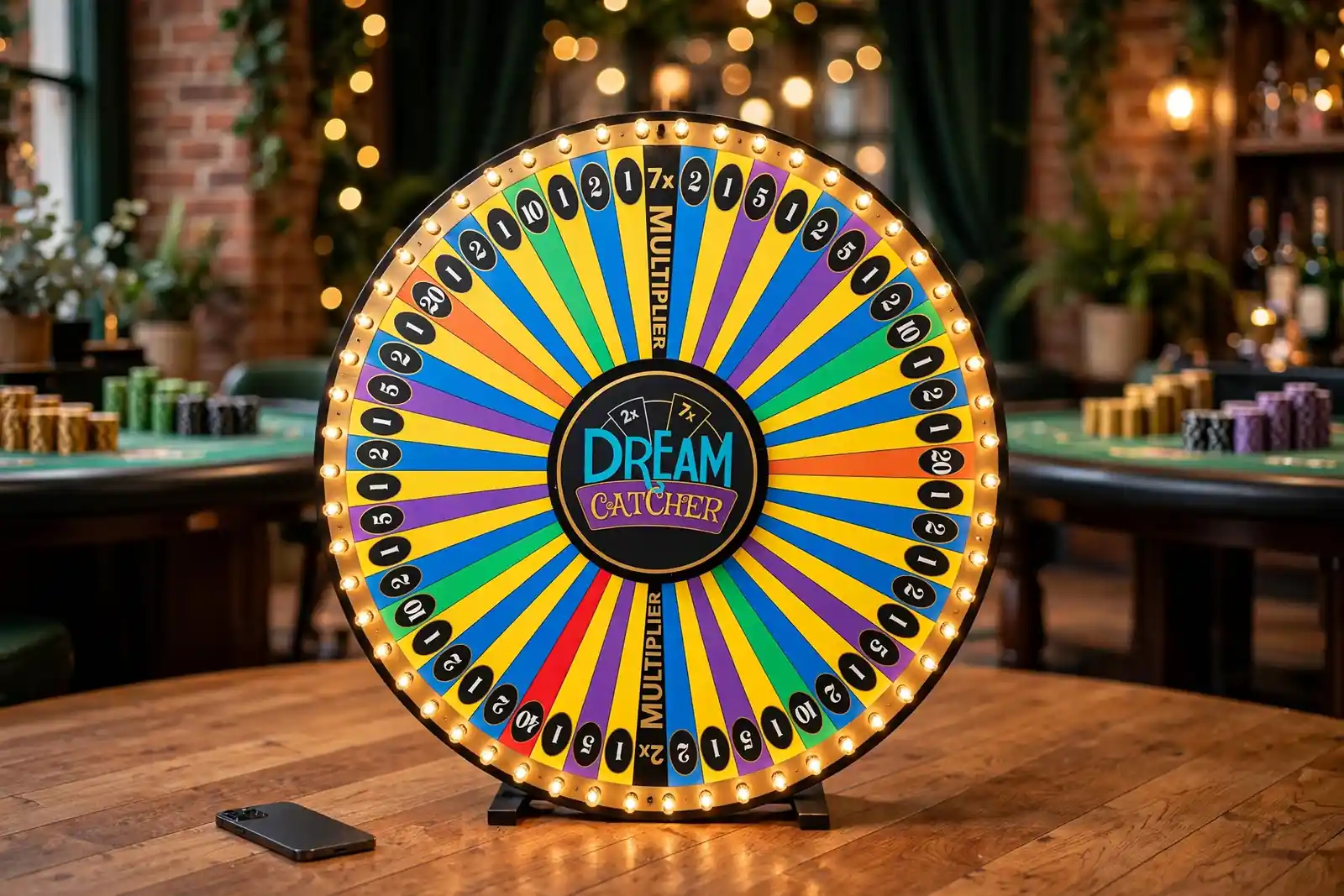
How Live Dream Catcher Is Delivered Online
The word “live” describes how a casino game is presented, not a different way of connecting to a casino. In a live-dealer format, gameplay is streamed in real time from a studio, where a human dealer runs the game. Bets are submitted through an on-screen interface while the stream shows the action as it happens.
That distinction matters when looking for Dream Catcher online. A title or search result may use “live” to describe the experience, but the general format alone does not confirm the details of a particular game or how it is made available. The delivery model can be explained without assuming game-specific rules: a studio provides the live action, the dealer conducts it, and the online interface carries the player’s bets to the game.
The studio stream and the betting interface
A live-dealer casino combines two elements that serve different purposes. The video stream presents the real-time game, while the on-screen interface lets players take part remotely. The dealer is physically present in the studio; the player is not. The bet is made digitally, rather than by placing chips on a table in the studio.
For a live Dream Catcher session, choosing a casino is part of the experience: it is worth checking the practical details as well as the game itself. This list gives you a concise reference for considering the options.
-
Britsino
- Payout speed
- 1-3 business days
Britsino lists a payout speed of 1–3 business days, a practical detail to consider when choosing where to play.
-
Amunbet
- Payout speed
- 1-3 business days
Amunbet lists a payout speed of 1–3 business days, giving players a stated timeframe to keep in mind.
-
Dieselwin
- Payout speed
- 1-3 business days
Dieselwin lists a payout speed of 1–3 business days, which is useful information when considering the operator.
-
BeOnBet
- Payout speed
- 1-3 business days
BeOnBet lists a payout speed of 1–3 business days, offering a clear detail to factor into your choice.
-
Jetsetspins
- Payout speed
- 1-3 business days
Jetsetspins lists a payout speed of 1–3 business days, providing a stated timeframe for payouts.
-
SpinFormula
- Payout speed
- 1-3 business days
SpinFormula lists a payout speed of 1–3 business days, a useful point to note when weighing your options.
-
Revery Play
- Payout speed
- 1-3 business days
Revery Play lists a payout speed of 1–3 business days, giving you a specific payout detail to consider.
-
WinBeast
- Payout speed
- 1-3 business days
WinBeast lists a payout speed of 1–3 business days, a practical consideration for players.
-
Chanze
- Payout speed
- 1-3 business days
Chanze lists a payout speed of 1–3 business days, so its stated payout timeframe is worth noting.
-
Zombillion
- Payout speed
- 1-3 business days
Zombillion lists a payout speed of 1–3 business days, providing one concrete detail for your decision.
This is the basic arrangement behind an online casino offering a live game. It is not the same delivery method as a fully digital version, where the game action is generated on screen rather than shown as a live studio event. The live format places a human dealer and a real-time stream at the centre of the experience, with the interface acting as the connection between that event and the remote player.
For someone looking for an online casino with Dream Catcher, this explains what “live” would mean if the game is offered in that format. It does not, by itself, establish the game’s rules, betting options, table conditions or availability. Those details belong to the particular game and operator, not to the general live-dealer model.
The interface is also more than a viewing window: it is where bets are placed. That makes the screen the practical link between watching the studio and participating in the game. The dealer’s actions are shown through the stream, while the betting controls are handled online. The two parts operate together, but they should not be confused: seeing a dealer on screen does not mean the player is using a physical casino table.
What “real time” means in practice
Real-time streaming means the game is presented as it is conducted in the studio rather than as a replay or a sequence generated entirely by a digital game. The format gives the online session a live event to follow. It also means the pace is not simply set by a rapid sequence of software-generated outcomes. Live games move more slowly than their digital counterparts, because the dealer-led process takes place on screen.
 Live Baccarat Online Casinos in the UK: How It WorksLearn how live baccarat hands are dealt, how Player, Banker and Tie bets are settled, and why third-card rules matter before betting.
 Aviator Casino Game UK: Licensing and PlayLearn how the UKGC boundary separates regulated casinos from offshore platforms, and how to assess Aviator play, bonuses and game claims.
That slower pace is a structural feature, not a promise of a more favourable outcome. The format changes how the action is delivered; it does not make a bet safer or improve its chances of winning. Nor does a human dealer change the fact that the player is participating through an online casino interface.
The stream also depends on a stable internet connection. If the connection is unreliable, the video experience may be interrupted or become difficult to follow. This is a practical condition of streamed play, rather than a special feature of Dream Catcher. The same basic dependency applies to live-dealer games generally.
Separating format from game claims
A description of live delivery should remain separate from claims about the particular game. “Dream Catcher online casino” can refer broadly to a search for a casino experience involving that name, but the words alone do not establish whether a specific listing is live, what its rules are, or what conditions apply. The relevant distinction is between the general format and the individual offer.
Where a game is presented as live dealer, the defining elements are the studio stream, the human dealer and the online betting interface. Beyond those points, details need to be checked against the game and operator information rather than inferred from the label. That is especially important when several online casinos appear to offer similarly named experiences: a shared name does not prove that their game conditions are identical.
The cost of the format is also part of the distinction. Live games have higher minimum bets than digital versions, as well as a slower pace. Those conditions can affect whether a live table suits a particular budget, even before any game-specific rules are considered. The label “live” therefore describes both a delivery method and a different playing environment; it is not merely decorative wording on a casino page.
The basic answer to how a live Dream Catcher experience is delivered online is therefore conditional but clear: where it is offered as a live-dealer game, the action comes from a real-time studio stream, a human dealer conducts the game, and bets are placed through the on-screen interface. That describes the format, not the specific rules or availability of any one Dream Catcher listing. This content is for entertainment purposes only and is not gambling advice.
Dream Catcher Casino in the UK: What Can Be Verified
The phrase “Dream Catcher casino” can point to different things: a game title, a live table shown on a casino site, or simply a search for somewhere to play. Those are not interchangeable. A game name does not identify the company offering access, and a page mentioning Dream Catcher does not by itself establish that the game is available to UK players.
The firm point about the UK market is the licensing condition. A live-dealer casino is legal in the UK when it holds a licence from the UK Gambling Commission. That condition concerns the operator providing the gambling service; it should not be confused with a claim about a game’s rules, presentation or current availability. For a search such as “live Dream Catcher casino UK”, the operator’s status is therefore a separate question from whether a particular table is listed.

A useful distinction is between what can be checked about the market and what a page claims about this game. The UK licensing requirement is a market condition. Statements that a named Dream Catcher table is live, accepts UK customers, has particular features or follows particular rules need separate, specific evidence. A title in a menu, an image, or a general description is not enough to establish all of those points. The wording may describe a product category rather than confirm a playable table.
That distinction matters because casino pages can combine several layers of information. A page may refer to a game, the operator hosting it, a live-dealer category or a promotional feature. Each claim has a different subject. An operator’s licence does not verify the rules of every game it lists; similarly, a game description does not establish that the casino offering it is licensed for the UK. Treating one as proof of the other turns a narrow fact into a much broader claim.
For a UK player, the legal threshold is not a matter of presentation. A site can use familiar language such as “live casino” or display a polished game page, but those details do not replace the requirement for the relevant UK Gambling Commission licence. A live-dealer casino is within the legal UK market only on that licensed basis. The word “UK” in a page title or web address is not a licence, either.
The same care applies to lists of “Dream Catcher casinos”. A list may be useful as a starting point, but its heading alone does not prove that every named operator currently offers the game to UK customers. Nor does the presence of a casino in a list establish the operator’s licensing position. Those are distinct claims and should not be collapsed into a single endorsement. A list that provides no clear operator identity or licensing context leaves an important part of the picture unresolved.
Descriptions of a “Dream Catcher live casino” may also sound more definite than the information behind them. The wording can imply a dedicated venue, a particular table format or a game with specified mechanics. None follows automatically from the label. A careful account should identify what is being described and avoid presenting inferred details as confirmed features. If a page does not make the operator and the nature of the offering clear, the name alone cannot fill those gaps.
The phrase “live Dream Catcher” can therefore be read as a request about access, but it is not evidence that access is currently available. Availability is a claim about an operator’s present offering; legality is a claim about the operator meeting the UK licensing condition. They answer different questions. A casino could meet the licensing condition without offering the named game, while a page could mention the game without establishing the operator’s UK status.

This is also why broad claims about “Dream Catcher casinos UK” should be read narrowly. A search result may bring together pages that discuss a game, review a casino or describe a live-dealer category. Those materials are not equivalent to confirmation from the operator that a particular table is available under its UK service. The more specific the claim—availability, table rules or a named feature—the more specific the supporting information needs to be.
For the 2026 wording in the search phrase, the year does not itself establish a change in the game or its UK availability. It is a date attached to the request, not proof of a launch, revised rules or a current listing. The defensible starting point remains the same: live-dealer casinos are legal in the UK when operated under a UK Gambling Commission licence. Claims beyond that—especially about Dream Catcher itself—need to be treated as claims about the particular operator and offer, rather than as consequences of the game’s name.
Choosing a Live Table: Terms Before Presentation
A polished studio and a prominent game tile do not establish that a live table is good value. The comparison is more useful when it starts with conditions that can be checked: whether the operator is licensed for the British market, what the table requires to place a bet, how quickly play proceeds and whether any bonus can be used there. These points apply when assessing a live Dream Catcher option as much as any other live table. They do not, by themselves, establish a ranking of casinos or confirm particular features of the game.
- Verify the operator holds a UK Gambling Commission licence
- Check the specific table's minimum bet requirement
- Review the pace of play compared to digital versions
- Confirm if bonuses are eligible for live-table use
- Check the wagering contribution weighting for the game
Start with the operator’s status
For real-money online gambling in the UK, the operator serving customers must hold the relevant UK Gambling Commission licence. That is a threshold condition, not a quality score. Presentation, game labels and promotional wording cannot replace it; an operator’s status is a more material comparison point than the appearance of a lobby.
After that, the table’s own terms determine whether the option fits the intended spend. Minimum stakes are particularly important because they set the amount required for each betting decision. A table can be legally offered and still be unsuitable for a particular budget. The practical comparison is therefore not simply which casino displays a game, but whether its stated conditions leave room to play without exceeding a planned limit.
Treat minimums as table-specific
A specialist review has reported live roulette and baccarat tables starting at around 20p, with blackjack tables often opening at higher levels. That is a source-specific observation, not a stable market-wide tariff, and it does not establish the minimum for Dream Catcher. Table limits can differ, so the amount shown for the specific table is the relevant figure.
The distinction matters when comparing headline offers. A low advertised entry point elsewhere does not prove that a particular live table accepts the same stake. Nor does a casino’s general minimum deposit answer the question: a deposit threshold and a table’s minimum bet are different conditions. The table information should be checked directly before treating the game as affordable.

Live games also run at a slower pace than digital versions. That changes the number of betting decisions that fit into a period of play, but it does not make a table cheaper per decision. A lower minimum and a slower round rate are separate attributes; neither should be used as a substitute for checking the other. The useful comparison is the stated table stake alongside the pace of that game, rather than an overall claim that one casino is cheaper or faster.
Calculate the usable value of a bonus
A welcome offer has value for live-table play only if its terms allow it to be used there and explain how that play counts toward wagering requirements. A specialist review has described UK welcome offers as commonly consisting of slot free spins that cannot be used at live tables. This is a report about offers, not a guarantee that every promotion has the same structure. The specific terms control.
Even where live play is eligible, its contribution may be limited. Live games can count for only a small proportion of wagering requirements; one cited weighting is 10%. The headline bonus amount therefore cannot be treated as an equivalent amount of live-table credit. If a promotion assigns little contribution to the chosen game, the bonus may add little practical value to that activity, regardless of how prominent it appears.

The relevant calculation has three parts: whether the game is eligible, what contribution the rules assign to it, and what wagering conditions apply before any resulting balance can be withdrawn. If eligibility is excluded, the offer contributes nothing to the live session. If the weighting is low, eligible play advances the requirement only partially. A large headline figure does not change either result.
Compare conditions, not labels
A fair comparison keeps the same questions in view for each option: is the operator licensed for the UK market; what minimum does the specific table display; how does its pace compare with digital play; and do the promotion’s rules count that game, and at what weighting? The answers are more useful than a badge such as “best” attached to a casino or game.
No single condition settles the choice. A lower table minimum may matter more than a promotion that excludes live play; a bonus that permits live play may still have limited value if its contribution is small. The final assessment rests on the table’s actual terms and the offer’s written conditions, not the order in which a casino presents them.
Playing the Live Game: Pace, Interface and Limits
A live casino game runs through a video stream from a studio, where a human dealer conducts the play. Bets are submitted through the casino’s on-screen interface rather than placed physically at a table. That division matters: the dealer manages the live action, while the interface carries each player’s betting decisions to the game.

The screen is therefore part of the playing process, not merely a window onto the studio. A decision has to be entered through the available controls, and the stream must remain clear enough to follow what is happening. The exact layout and controls depend on the game and operator. A Dream Catcher casino game should not be assumed to use the same interface or timing as another live title simply because both are streamed.
Pace is part of the format
Live games move more slowly than digital versions. The dealer-led sequence takes place in real time, so the pace is tied to the studio action rather than to an instantly generated result. That can leave less room for rapid, repeated decisions than a digital game. The difference is structural, not a mark of better value: a slower round does not improve the terms of a bet.
This distinction is relevant when considering whether to play a Dream Catcher live casino game. The title alone does not establish how quickly a session will feel, what controls will appear, or what a particular operator’s table allows. The dependable point is broader: live play includes a real-time stream and human dealer, and its pace is slower than that of a digital equivalent.
The connection is a playing condition
A stable internet connection is necessary because the game is delivered as a stream while bets are made through an interface. If the video stalls or the connection drops, the player may lose a clear view of the live action or have difficulty following the on-screen process. Connection quality is therefore part of the practical conditions of play, not a minor technical detail.
The stream and the betting controls also need to be understood as related but distinct parts of the experience. Seeing the dealer does not remove the need to use the interface correctly; using the interface does not make the live sequence faster. Before placing a bet, the displayed options and the applicable table information should be clear. If the screen does not provide enough information to make a decision, proceeding would add uncertainty without changing the underlying game.
Limits are not the same as speed
Live tables have higher minimum bets than digital versions. That can make the cost of entering a live game different even where the game’s general format appears familiar. The minimum is a table condition, while pace describes how quickly the live action proceeds; neither should be mistaken for a promise about outcomes.
A request to play a Dream Catcher casino game online does not, by itself, establish the minimum or the interface terms at any particular table. Those details belong to the displayed game information and can vary by offering. The practical sequence is straightforward: follow the live action, use the on-screen interface to place bets, and account for the slower pace and the connection needed to keep the stream usable. No interface can remove the financial uncertainty of gambling.
This section is for entertainment purposes only and is not gambling advice.
The Wheel Behind Live Roulette
A casino wheel can look like roulette without following roulette’s mechanics. The distinction matters when a game is described in broad terms as a wheel game: roulette has a numbered wheel and a ball, while other formats may use different equipment and rules. The presence of a spinning wheel alone does not establish that a particular game is roulette.

In live roulette, a dealer spins a physical wheel and releases the ball. The result comes from where the ball lands, and a bet wins when it matches the selected number or outcome. The wheel and ball are shown as the round happens. Computerised roulette works differently: software uses a Random Number Generator to determine the result rather than a ball settling into a physical pocket.
That difference is about how the result is produced, not a promise that one format is more predictable. A live image of a wheel does not make its next landing knowable; a computer-generated result does not provide a pattern to follow either. Each format presents a different process, while the relevant comparison still depends on the game’s stated rules and layout.
European and American layouts
The key layout distinction is the number of green pockets. European Roulette has a single green pocket marked 0. American Roulette adds a second green pocket, marked 00, alongside 0. The extra pocket changes the number of possible landing positions, and therefore the chance of a single-number selection winning.
For a single number, the stated chance is 1 in 37 on the European layout and 1 in 38 on the American one. The American wheel’s additional pocket makes the chance lower. The visual difference is small—one extra green marking—but the probability difference is fixed by the layout, not by how quickly the wheel turns or how the dealer releases the ball.
European Roulette
Features a single green pocket marked 0, with a 1 in 37 chance for a single-number win.
American Roulette
Includes two green pockets (0 and 00), resulting in a 1 in 38 chance for a single-number win.
This is why the wheel format should be identified before comparing roulette offers or rules. “Live” describes the dealer-led, physical-wheel presentation; “European” and “American” identify layouts with different pocket counts and number odds. They answer separate questions. A stream can show a real dealer without establishing which roulette layout is in use, so the table information needs to specify that detail.
For anyone looking at a casino wheel in connection with Dream Catcher, roulette is a useful comparison only if the game is actually presented as roulette. The term “wheel” by itself is not enough to infer a numbered roulette layout, a ball, or roulette probabilities. Those features belong to roulette’s rules; they should not be transferred to another named game without evidence.
What to Check on a Live Casino Site
A site offering live dealer games to people in the UK must hold a current operating licence from the UK Gambling Commission. The relevant check is the licence held by the operator, not a logo, a claim in a footer or the location of a studio. An operator based elsewhere still needs the required UK licence when serving the British market.
The operator’s legal name should be identifiable on the site and match the name shown in the Commission’s public register. If the names differ, the relationship between them needs to be clear; a licence belonging to another company does not establish that the site itself is covered. The Commission’s register provides a way to check the operator rather than relying on the site’s own wording.

For anyone comparing live Dream Catcher casino sites, that legal check comes before the game tile or promotional presentation. A listing alone does not establish that a particular game is available, that it is live, or that the operator is licensed. Those are separate claims and should not be treated as interchangeable.
The live format has a concrete meaning: gameplay is streamed in real time from a studio, a human dealer runs the game, and bets are submitted through an on-screen interface. A site describing a game as live should make that distinction evident in the play interface. A prerecorded video or computer-generated result is not the same thing as a live dealer game.
The licence and the format answer different questions. The first concerns whether the operator may legally serve the UK market; the second concerns what kind of game is being presented. Neither, by itself, establishes that a named title has particular rules or features. For a Dream Catcher listing, the site’s own game information should be read as a claim about that title, not as proof supplied by the general definition of live play.
A sound site-level assessment therefore rests on identifiable operator licensing and a clear live-dealer presentation. Brand language can make a page look specific; the licence record and the actual format are the checks that carry weight.
Demo Play: What It Can—and Cannot—Establish
A free-play version can provide a limited view of a game’s presentation and on-screen controls, if the operator makes one available. That is useful for assessing whether the interface is clear enough to follow. It is not evidence that the same title is offered in a live-dealer format, or that a live version will behave identically.
This distinction matters when looking for a Dream Catcher demo. A listing or preview labelled as a demo does not, by itself, establish that it shows real-time studio play with a human dealer. That format involves a live stream and bets entered through an interface; a static preview or simulated game does not demonstrate those features. The label is not the product specification.
Free play also cannot establish what a real-money session would return. A demo does not produce real winnings, and any result shown in it has no cash value. It should not be treated as a forecast of later outcomes or as a way to test whether a game will be profitable. Presentation can be examined; future returns cannot be inferred from it.
The limits are especially important when the game’s rules and features have not been confirmed. A trial screen cannot safely be used to assume particular betting options, round structure or payout terms for Dream Catcher. Those details need to be available in the game information or rules before money is involved. If they are not displayed, the demo does not fill the gap.
A useful assessment therefore separates three things: what the screen visibly shows, what the published rules state, and what remains unconfirmed. Controls and layout may be visible in a trial. Rules and payouts require written terms. A real-money outcome cannot be established in advance by either.
The short version is arithmetic rather than marketing: free access may reduce uncertainty about the interface, but it does not create a cash return, verify a live-dealer version or settle the rules. Any demo remains entertainment, not gambling advice.

Reading a Live Casino Review Against the Rules
A review of Dream Catcher should separate claims about the named game from evidence about live casino play in general. Roulette details can be checked against roulette rules; they do not establish that Dream Catcher uses a wheel or follows roulette payouts. A review that moves between those subjects without making the distinction is not giving a reliable account of the game.
For roulette, the table layout is a useful check. American Roulette includes both a zero and a double-zero pocket, shown as 00 on the wheel and betting layout. If a review describes an American table but omits the double zero, its account is incomplete. The detail matters because a house-edge figure is meaningful only when tied to the relevant game and bet type.
The stated house edge for a straight-up roulette bet is 2.9%; for other bets, it is 2.7%. Those figures should not be collapsed into one general “roulette edge”. A review that gives a single number without saying which wager it describes has left out a material condition. Likewise, a claim about Dream Catcher cannot be substantiated merely by quoting roulette figures: the game’s own rules and payout structure would need to support it.
The same standard applies to descriptions of presentation. A live casino review may discuss a real-time dealer format, but that does not prove a particular title has a specific wheel, layout or betting option. Separate what the review directly demonstrates from what it assumes by association. Clear labels—game format, table rules, bet type and applicable edge—make the difference between a checkable statement and decorative precision.
A useful review therefore earns confidence through traceable detail, not through confident wording. Its claims should identify the game being discussed and avoid transferring roulette mechanics to another live title. Any linked recommendation should also make clear when links are referral links. This content is for entertainment purposes only and is not gambling advice.
Before Playing: Budget and Connection
A budget set before a live session is a spending limit, not a target to reach. It should reflect money available for entertainment, with no assumption that a losing session can be recovered by continuing. Once the limit is reached, play stops; extending it to chase losses turns a defined cost into an open one. The same applies after a win: a favourable result does not justify raising the original limit.
This matters when planning to play Dream Catcher live casino, or any other streamed table. Live games move more slowly than digital versions and can have higher minimum bets. Those conditions affect how long a budget may last and how much can be committed at a time. The table’s minimum therefore belongs in the calculation before play begins, rather than being treated as a small detail after joining.
A stable internet connection is also a practical requirement. Live gameplay is streamed in real time, so a weak or interrupted connection can disrupt the session. Connection problems do not change the budget or make additional play a sensible way to compensate for lost time. If the stream is unreliable, stopping is more controlled than continuing under uncertain conditions.
The useful calculation is straightforward: decide the affordable loss in advance, compare it with the table’s minimum, and keep the session within that amount. A live table’s presentation may feel immediate, but the spending boundary needs to be set before the first bet. This is entertainment, not financial advice, and neither a win nor a technical interruption changes the amount allocated to play.

Bonuses and the Cost of Live-Table Terms
A casino offer can look substantial in headline value and still contribute little to live-table play. A specialist review describes UK welcome promotions as commonly built around free spins on slots, which cannot be used at live tables. That is a report about the offers it assessed, not a guarantee that every operator uses the same format; the promotion’s own terms determine what applies.
The second cost appears in wagering requirements. Live games may contribute only a small proportion of qualifying play: a stated weighting of 10%, for instance, means that only a fraction of the live-game stake is counted towards the requirement. The promotional balance can therefore take considerably more eligible activity to clear than the headline suggests. If Dream Catcher is the intended game, its eligibility and weighting need to be confirmed in the specific offer terms rather than inferred from the fact that it is available at a live table.

The useful comparison is between the offer’s conditions and the play it can actually support. Check which games qualify, how each category is weighted, whether a maximum bet applies while wagering, and what amount of wagering is required. A free-spin package has no direct value for live play if live tables are excluded. A live-game contribution may add some value, but a low weighting reduces it; the calculation should use the permitted contribution, not the promotional headline.
This is also why a search for a casino featuring Dream Catcher does not settle whether its bonus suits that game. Game availability and bonus eligibility are separate terms. Before opting in, the relevant figures and exclusions should be clear in the promotion rules. If they are not, the offer’s value for live-table play cannot be calculated reliably.
How do you play live roulette?
A dealer spins a physical wheel, and you place bets through the on-screen interface while watching the game in real time. You win if the ball lands on a number you selected.
What are the different types of roulette you can play with a live dealer?
Live roulette includes European and American versions; American roulette has both 0 and 00, while European roulette has only 0. French roulette also has a rule under which an even-money bet loses only half when the ball lands on zero.
How do you choose a live dealer casino?
Choose a UK operator with a UK Gambling Commission licence, then check the table’s minimum bets and the casino’s bonus wagering terms. Live games generally move more slowly and have higher minimum bets than digital versions.
What is the difference between European and American Roulette?
European roulette has one green pocket, 0, while American roulette has two, 0 and 00. The odds of winning are 1 in 37 on European roulette and 1 in 38 on American roulette.
How does the house edge change between games?
In roulette, straight-up bets have a 2.9% house edge, while other bets have a 2.7% edge. In French roulette, an even-money bet loses only half if the ball lands on zero.
Casino Games in the UK: Slots, Live Play and More
Content created by the «Apcelero.com» team