
Understand the rules before choosing a table
 Available in US
A practical overview of zero rules, table limits, live play, roulette formats, payouts and the limits of betting systems.
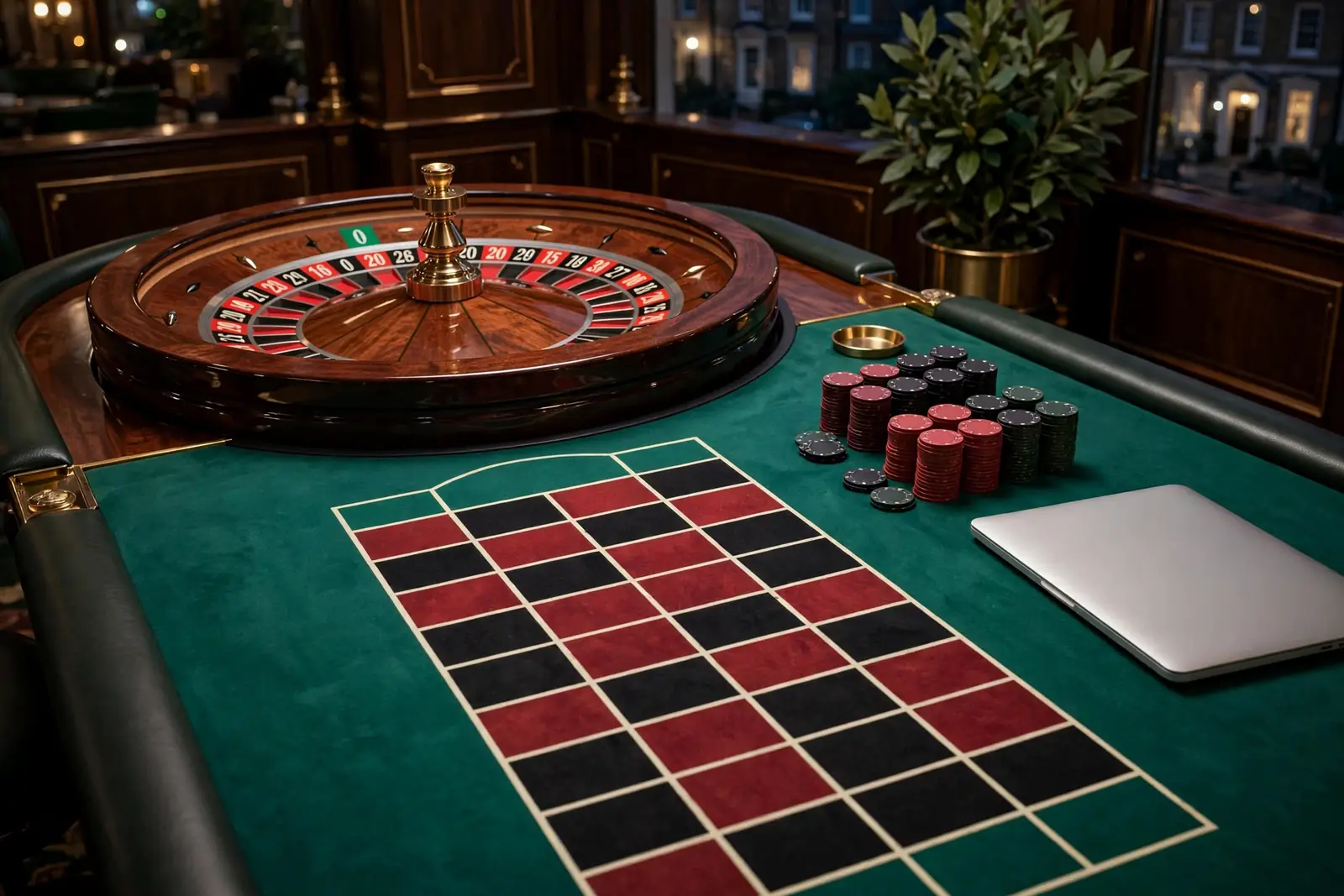
French Roulette’s Zero Rule and the House Edge
French roulette is distinguished by what happens to qualifying even-money bets when the ball lands on zero. La Partage returns half of the stake, rather than treating the whole bet as lost. En Prison is another zero rule associated with French roulette. Together, these rules give the variant its lower house edge among standard roulette games.
The distinction matters because zero is not simply another number on the layout. It creates the house’s advantage over time: a bet on red, for instance, wins when red appears, but zero is neither red nor black. Without a special rule, a zero result makes that even-money wager a loss. La Partage changes the settlement. The bet still loses part of its value, but not all of it.
How La Partage changes an even-money bet
Even-money bets are those that pay the same amount as the original stake when successful. Red or black, odd or even, and low or high are familiar examples. Under La Partage, if the ball lands on zero, half of a qualifying stake is returned. The other half is lost.
When choosing an online casino for French roulette in the UK in 2026, payout timing is one practical detail to check alongside the game rules. This list gives you a quick reference for the payout speed noted for each operator.
-
Britsino
- Payout speed
- 1-3 business days
Britsino has a listed payout speed of 1–3 business days.
-
Amunbet
- Payout speed
- 1-3 business days
Amunbet has a listed payout speed of 1–3 business days.
-
Dieselwin
- Payout speed
- 1-3 business days
Dieselwin has a listed payout speed of 1–3 business days.
-
BeOnBet
- Payout speed
- 1-3 business days
BeOnBet has a listed payout speed of 1–3 business days.
-
Jetsetspins
- Payout speed
- 1-3 business days
Jetsetspins has a listed payout speed of 1–3 business days.
-
SpinFormula
- Payout speed
- 1-3 business days
SpinFormula has a listed payout speed of 1–3 business days.
-
Revery Play
- Payout speed
- 1-3 business days
Revery Play has a listed payout speed of 1–3 business days.
-
WinBeast
- Payout speed
- 1-3 business days
WinBeast has a listed payout speed of 1–3 business days.
-
Chanze
- Payout speed
- 1-3 business days
Chanze has a listed payout speed of 1–3 business days.
-
Zombillion
- Payout speed
- 1-3 business days
Zombillion has a listed payout speed of 1–3 business days.
That partial refund reduces the house edge on eligible bets to 1.35%. It does not remove the house advantage, and it does not make a winning result more likely. It changes the financial consequence of one particular outcome: zero. Over repeated play, losing only half the stake on zero is less costly than losing the full stake, which is why the edge is lower.
The qualification is important. La Partage applies to even-money bets, not automatically to every wager on the table. A bet placed on a single number or another non-even-money selection should not be assumed to receive the same refund. The rule’s value depends on the type of bet and on whether the table actually offers La Partage.
A French layout alone is not enough to establish how a particular wager will be settled. The displayed rules govern. Where La Partage is available, the practical difference is straightforward: a zero result cuts the loss on a qualifying even-money bet in half. Where it is not available, that refund cannot be included in the calculation.
En Prison and the French edge
En Prison is the other rule associated with French roulette’s reduced house edge. Its name describes a bet being held rather than immediately settled after zero. The rule is relevant to the same broad problem as La Partage: zero would otherwise cause an even-money bet to lose its full stake.
 Casino Games in the UK: Slots, Live Play and MoreExplore UK casino game topics, from slots and crash games to roulette, live tables, bingo, bonuses and fast-payout casino searches.
 Crazy Time Live Casino in the UK: Format and AccessLearn how live-streamed play and betting interfaces work, what a UK Gambling Commission licence covers, and where casino listings leave questions unanswered.
The precise settlement depends on the table’s stated rules. En Prison should therefore be treated as a separate condition to verify, not as another name for La Partage. The two rules address the effect of zero, but they do so through different procedures. A table may describe one rule, the other, or the terms that apply to its own game. The relevant wording is the rule panel, not the game’s French label.
This distinction is useful when assessing a French roulette casino. The name of the variant does not, by itself, confirm which zero rule is active for a particular game or bet. The rule information should make clear what happens after zero and which wagers qualify. Without that detail, the claimed advantage cannot be applied reliably to a stake.
What the lower house edge does—and does not—mean
French roulette has the lowest house edge among standard roulette variants because of La Partage and En Prison. That is a comparison of the game’s built-in terms, not a prediction about an individual session. A lower edge means the rules are less costly to qualifying bets over time; it does not ensure that any particular bet will win or that a short run will resemble the long-run expectation.
The calculation also has a boundary. La Partage’s 1.35% edge applies to the even-money bets covered by the rule. It should not be presented as the edge for every bet available in French roulette. Other wagers have different payouts and exposure to zero, so the half-stake refund cannot simply be carried across the entire layout.
For a player comparing French roulette online casinos, the decisive question is therefore not just whether the game is labelled French. It is whether the relevant table specifies La Partage or En Prison, and whether the intended bet is covered. The difference is small in appearance at the point of a single zero, but it is the mechanism behind French roulette’s lower standard house edge. A refund of half a qualifying stake is not a winning strategy; it is a more favourable settlement rule.
What Makes a French Roulette Casino a Better Fit
A suitable French roulette casino is not identified by a label on its homepage. The useful comparison is between the rules attached to the actual game, the way it is presented and the information available before play. A casino may offer roulette without offering a table that applies the French rules that matter.
Confirm the rules at table level
The first check is whether the game’s rules specify La Partage, En Prison, or both. A French-themed title or a French-style layout is not enough to establish which rules apply. The table information should make clear what happens when the ball lands on zero and whether the rule covers the bet being placed. If that detail is missing, the game cannot be assessed on the feature that distinguishes French roulette.
The rules should also be visible before a stake is committed, rather than left to inference from the table name. Where several roulette titles appear in one lobby, each should be assessed separately. Similar graphics do not mean identical rules, and a label used in a lobby does not replace the game’s own terms.
 Hi-Lo Casino UK: Rules, Returns and StrategyLearn how each next-card guess is judged against the current reference card, and compare live and online play, returns, strategy and site…
 High Volatility Slots in the UK: Stakes and ReturnsLearn how reel layout, stake size, volatility, RTP and bonus terms affect a slot session. A five-reel layout does not show the…
This is a practical distinction, not a wording preference. European roulette has a house edge of 2.70%, but that figure alone does not tell whether a particular table applies the French rules. The table’s stated rules determine what the game offers; the general category name does not.
Compare like with like
A fair comparison holds the relevant conditions steady. Check that the tables being considered use the same French rules, then compare their presentation and available information. If one table states its rules clearly and another does not, the uncertainty is part of the comparison. It should not be treated as a minor design difference.
Game format is another selection factor, but it answers a different question from the rules. A digital game and a dealer-hosted game may feel different to use, yet neither format by itself proves that La Partage or En Prison is in force. In a dealer-hosted game, a real wheel is filmed in a studio while dealers manage the physical ball and the round. The rules still need to be checked independently.
The interface matters in practical ways: the rules and payouts should be legible, the betting layout should be clear, and the relevant game information should be easy to locate. These features do not improve the odds. They reduce the chance of mistaking one set of conditions for another.
Do
- Verify if the table specifies La Partage or En Prison
- Check that rules are visible before committing a stake
- Compare tables using the same French rules
Don't
- Rely on a "French" label to confirm active rules
- Assume similar graphics mean identical rules
- Use a general casino rating to establish table details
Treat published information as part of the offer
A casino’s information is useful only if it allows the game to be evaluated. Look for the table rules, the game’s RTP information and the terms that govern access to it. UKGC-licensed operators must make RTP information accessible. If the figure or rules cannot be found, the comparison is incomplete; a polished lobby is not a substitute for disclosure.
The operator’s general terms also matter, but they should not be confused with the roulette rules. Account conditions, eligibility wording and any restrictions attached to a promotion can affect the overall value of an offer without changing the game’s mechanics. Promotional terms belong in a separate calculation: bonus funds are not the same as a better roulette table.
A disciplined comparison therefore records separate points: the table’s French rules, its format, the availability of game information and any relevant account terms. Combining these into one broad impression makes it harder to see which condition is doing the work. “Best” is not a measurable property unless the comparison states what is being valued.
Use a defined standard, not a ranking label
For someone looking for the best French roulette casino in the UK, the useful standard is a verifiable match between the advertised game and its rules, with clear information available before play. The answer can vary according to whether the priority is a particular French rule, a preferred format or transparent game details. A general casino rating cannot establish those points on its own.
The operator’s licence is a separate threshold, not a quality score. Real-money casino operators serving Great Britain must hold the relevant UK Gambling Commission licence. Licence status should be checked on the Commission’s public register before depositing. That check does not confirm that a particular roulette table uses French rules; the table information must do that.
 Fastest Payout Online Casino UK: What Can Be VerifiedLearn why casino payment claims do not establish when winnings reach a player, and how game-prize rules differ from withdrawal speed.
 Deal or No Deal Casino UK: Game Format ExplainedSee how offers, briefcases and the final choice shape online Deal or No Deal, including the 16-case format and the first-round decision.
The comparison can end with a simple record: which French rules are explicitly stated, whether the table’s game information is accessible, which format is offered and whether the operator’s conditions are clear. A casino that cannot answer those points is harder to evaluate, regardless of how prominently it advertises French roulette. A better fit is the one whose actual terms match the criteria, not the one with the strongest adjective.
Live French Roulette: Real Wheels and UK Safeguards
Live French roulette combines a streamed physical wheel with a human dealer and an actual ball drop. That distinguishes it from a digital simulation: the result comes from the studio wheel, while the table interface carries the betting layout and records selections for the round. The camera feed is part of the game, not a decorative layer over a random-number display.
The French label still needs checking at table level. A live table should make its rules available before play, including whether La Partage and En Prison apply and which bets qualify. The name alone does not establish the rules in force. A French layout can be presented in a live studio, while the operator’s game information determines the terms attached to that particular table.
“Live auto” can also be an unclear label. An automated or auto-roulette table may still use a physical wheel, but the description should identify whether a dealer is present and how the round is run. The distinction matters to anyone choosing the human-dealer format: a live stream with a dealer is not the same experience as an automated table merely because both show a wheel.
Legal access and account controls
For British customers, real-money live roulette must be offered by an operator holding the relevant UK Gambling Commission licence. The UKGC is the sole regulator of online casino activity in Great Britain. A platform without a valid UKGC licence cannot legally offer real-money live roulette to British residents. An overseas address or studio does not remove the licensing requirement for an operator serving this market.
Age verification is a condition of account access: operators must verify a customer’s age before permitting a deposit. Online gambling is legal for people aged 18 and over when it is provided by a UKGC-licensed operator. Licence status can be checked against the Commission’s public register before funds are deposited; the operator’s own licence statement is not a substitute for that check.
UKGC-licensed live casino operators must provide account safeguards, not merely a link to general advice. These include deposit limits, loss limits, session time reminders, reality checks and cool-off periods. GamStop self-exclusion must also be available. New customers must be prompted to set a financial limit before their first deposit, and account-level limit controls must remain accessible afterwards. These controls affect the account, while the wheel determines the result of each round; one does not offset the other.
The payment boundary is also specific. UKGC licensees cannot accept credit cards for gambling, including credit-card funds routed through a money service business. A wallet cannot be used if it allows credit-card funds to finance gambling. These restrictions apply to the funding route as well as to a card entered directly at the casino cashier.

Information before play
Table rules and return information should be accessible before a live session begins. UKGC-licensed operators must make RTP information available for roulette games, so the relevant figure should be findable in the game information or operator’s help material rather than inferred from the French name. The published information should correspond to the game being selected.
There is also a route for resolving disputes. UKGC licensees must operate an internal complaints process and provide access to an approved Alternative Dispute Resolution service. That does not determine a disputed result automatically, but it gives complaints a defined path beyond an informal exchange with support.
The operational test is therefore straightforward: a real wheel and dealer establish the live format; the operator’s licence, accessible rules, RTP information and account controls establish whether the table is being offered within the British regulatory framework.
Low, Standard and VIP Table Limits
The minimum stake is the cash threshold for joining a table, not a measure of what a session will cost. A low-limit French roulette table can make individual bets smaller, but repeated spins still add up. The relevant comparison is therefore the displayed minimum alongside the pace of play and the amount set aside for the session.
A specialist review reports UK live roulette minimums starting at 10p, with auto-roulette and speed roulette sometimes starting at 5p. These are possible entry points, not a promise that every casino or French roulette table will offer them. Table limits vary by game and operator; the limit shown in the game is the amount that applies.
Low limits: a smaller entry point
For a low-stakes session, the table minimum matters because it sets the smallest permitted bet. A lower minimum gives more room to choose a modest stake without being forced into a larger one. It does not make outcomes more predictable or prevent a series of bets from using up a bankroll.
Auto-roulette and speed roulette can have lower stated entry points than live tables, according to the specialist review. That difference is useful only if the particular game also offers the French rules being sought. A low minimum on another roulette variant is not equivalent to a low-limit French table.
Standard limits: price the pace as well
A standard table’s minimum is only part of its cost profile. A specialist review puts standard-table pace at 80–100 spins per hour, while speed roulette can run at more than 150 spins per hour. At the same stake per spin, more opportunities to bet mean that the session’s total exposure can build faster. The faster format does not change the amount required to place an individual bet, but it can change how quickly the bankroll is put at risk.
Those pace figures are reported comparisons, not a guaranteed schedule for every table. Actual play depends on the game and its operation. The practical distinction remains: a low minimum controls the size of each permitted entry, while spin frequency affects how often another bet can be placed.

VIP limits: a higher threshold, not a different budget
VIP and high-limit tables are intended for larger permitted stakes. The label alone does not disclose the minimum or the maximum; the table’s displayed limits do. A higher limit expands the amount that can be wagered per spin, but does not create a financial advantage or compensate for losses. The cost of a session depends on the stakes chosen and the sequence of results, not the status attached to the table.
A useful comparison records the minimum stake, any maximum stake shown, and whether the game is live, automated or speed roulette. That keeps three separate questions separate: whether the entry price is affordable, whether the pace suits the intended session, and whether the table’s limits allow the chosen stake. A “standard” or “VIP” label cannot answer those questions by itself.
For French roulette, the advertised table name should also be checked against the rules displayed in the game. The minimum stake answers how little can be placed; it does not establish which rules apply. Table limits are concrete, but a category label is packaging.
Online Roulette Formats and Pocket Counts
Online roulette is available in several formats, but the screen does not make their mechanics interchangeable. RNG games generate outcomes digitally; live games show a physical wheel in a streamed studio; speed roulette is organised to move through rounds more quickly. The pocket count, meanwhile, depends on the roulette version rather than whether the game is streamed or automated.
RNG
Digital outcomes generated by a random number generator, often with lower minimum stakes starting at 10p.
Live
Physical wheels and dealers streamed via video, where results come from a real ball drop.
Speed
A faster-paced format capable of more than 150 spins per hour compared to standard tables.
RNG, live and speed formats
RNG roulette uses a random number generator to produce each result. There is no physical wheel or dealer to wait for, so the sequence of play can move faster than a live table. Minimum stakes can also be lower, with some RNG games starting at 10p. That combination can suit a smaller starting balance, although faster rounds can also mean more decisions in less time.
Live roulette presents a real wheel, a human dealer and physical ball drops through a video stream. The result comes from the wheel shown in the game, rather than a digital animation standing in for a spin. This format therefore adds the pace and presentation of a dealer-led table, while the stream itself does not change the wheel’s pocket count.
Speed roulette is a faster-paced format. A specialist review reports more than 150 spins per hour for speed roulette, compared with 80–100 at a standard table. Those are reported rates, not a guaranteed session pace: the number of rounds completed depends on the game and its operation. The practical distinction is the opportunity for more rounds in the same amount of time, not a different basis for predicting a result.
Single zero and double zero
European roulette has 37 pockets: numbers 1 to 36 and one zero. American roulette has 38: the same numbered range, a single zero and a double zero. That extra green pocket changes the chance of a winning outcome on a given spin and increases the house edge.

The stated house edge is 2.70% for European roulette and 5.26% for American roulette. The difference follows from the wheel’s pocket count: a bet that covers the same numbered outcomes has an additional losing pocket on the American wheel. The layout may look familiar, but the odds are not identical.
French roulette is commonly presented with a single-zero wheel, so the relevant pocket structure is the European one. The French label is not a separate RNG or live technology; it refers to the game’s rules and presentation. When comparing an online French roulette table with another game, the format tells how the spin is produced, while the pocket count tells which wheel is represented. Both details matter, and neither substitutes for the other.
A single-zero game can be offered as RNG or live roulette. Conversely, choosing a live table does not by itself establish whether the game is European, American or French. The displayed game information should identify the version before play begins. A double-zero layout carries a different edge even when the interface and betting grid resemble those of a single-zero table.
For online French roulette, the useful distinction is therefore two-part: confirm that the game uses the intended French rules, then identify whether it is an RNG or live presentation. Pocket count provides a quick check on the underlying wheel, while the format indicates how each round is delivered. A polished stream cannot remove an extra pocket, and a digital wheel cannot change the odds attached to its stated layout.
Finding UK Casinos That Offer French Roulette
A casino’s general roulette category does not confirm that French roulette is available. Game lists can include several roulette titles with different rules, so the relevant check is the individual game’s name and information panel. Searching the casino lobby for “French roulette” can narrow the list, but the rules shown on the selected table determine whether it is the French version being sought.
Availability can also vary between desktop and mobile lobbies or change as a casino updates its catalogue. A title appearing in a promotional image is not evidence that it is currently playable. The practical check is whether the game opens from the account’s casino lobby and displays its rules and table information. If the lobby does not make the variant clear, the operator’s support team can confirm whether that specific game is available to UK account holders.
Check the operator before opening an account
For customers in Great Britain, online casino gambling is regulated by the UK Gambling Commission (UKGC). Operators that offer remote gambling to the British market need the relevant UKGC licence, whether they are based in the country or elsewhere. A casino operating from overseas without that licence is outside the British regulatory system and cannot legally provide real-money gambling to British residents.
The licence check should be made against the UKGC’s public register, using the operator’s legal name rather than relying only on a logo or a statement on its own website. The register establishes whether the company holds a current operating licence; it does not confirm that French roulette is in its game catalogue. Those are separate checks, and both matter before money is deposited.

Age and identity checks are part of account access, not optional paperwork after play begins. A UKGC-licensed operator must verify a customer’s age before allowing a deposit into a gambling account. Online gambling is lawful in the UK for adults aged 18 and over when the operator holds the required UKGC licence. Account registration may therefore involve requests to confirm identity as well as age.
Confirm the game and its information
Before selecting a roulette title, open its rules or information panel and confirm the game variant. The title alone may not explain all the terms that apply. The same panel, or another clearly accessible game-information area, should provide RTP information for the roulette game. If the figure is not visible in the lobby, it should be possible to locate it through the game’s help screen or the operator’s support channel before play.
RTP is a useful published reference for comparing game information, but it is not a prediction of the result of an individual session. The displayed figure should be associated with the specific game rather than assumed from the casino’s general roulette page.
A sound availability check therefore has three parts: a current UKGC licence for the operator, confirmation that the French variant is actually accessible in the account, and access to that game’s rules and RTP information. A broad claim that a casino offers roulette does not settle any of them.
- Check the operator's licence on the UKGC public register
- Confirm the French variant is accessible in the account
- Review the specific table rules for La Partage or En Prison
- Locate the RTP information for the selected game
Premium Tables: The Cost of Higher Limits
A premium French roulette table is defined by the amount it permits a player to stake, not by a different kind of protection from losses. A higher permitted stake can make a table suitable for larger bankrolls, but it also increases the cash exposed on each spin. The label alone says nothing about whether the table offers favourable terms or whether its rules include La Partage and En Prison; those details need to be assessed separately.
The cost of a losing run is easiest to see as a simple calculation. If the same stake is placed on each spin, the amount lost across a run is the stake multiplied by the number of losing spins. At a higher stake, the same run consumes more of the bankroll. No special table status changes that arithmetic, and a losing streak can materially reduce the funds available for later play.
This is the relevant distinction when comparing premium French roulette casinos: a larger table maximum is capacity, not value. It can allow larger bets, but it does not make a result more likely or reduce the financial effect of losses. A player whose intended stake is small gains nothing from a high ceiling; a player using a larger stake needs a bankroll that can absorb the corresponding losses without relying on a win arriving at a convenient point.
The table’s minimum and maximum should therefore be read alongside the amount set aside for play. A maximum is not a target, and the ability to place a larger bet is not evidence that doing so is financially sound. When a session reaches the amount allocated for it, continuing because a premium table is available changes the exposure, not the odds.

There is also a practical distinction between a high-limit table and a premium experience. A table may carry a high permitted stake without offering any additional game feature. The name is less useful than the actual rules, stake range and the amount of bankroll each wager puts at risk. For a cash decision, those are the terms that matter; prestige is not a balance-sheet entry.
Roulette Bets, Payouts and Variants
A bet’s payout depends on how many numbered pockets it covers. In a French roulette casino game, the same basic layout of inside and outside bets applies as in other standard roulette versions; the payout is set by the bet type, not by whether play is online or at a physical table.
A straight-up bet selects one number. On European and American roulette, it pays 35:1 if that number wins. A split covers two adjacent numbers and pays 17:1. A street covers a horizontal row of three and pays 11:1. These bets concentrate the stake on fewer outcomes: the potential return is higher, but a winning result is correspondingly less frequent.
Outside bets cover broader groups. Red or black, even or odd, and high or low each pay 1:1. Their simple payout does not make them risk-free: a green zero can prevent an outside bet from winning. The exact treatment of that zero depends on the table’s rules, so the displayed game rules matter when comparing an online French roulette game with another version.
American Roulette Variants
American roulette typically features a double-zero wheel with a house edge of 5.26%. Some versions include a third green pocket (000), which results in a reported house edge of 7.69%.
American roulette also offers a basket bet, covering the zero, double zero, 1, 2 and 3. Its house edge is 7.89%, making it a costly choice relative to many other bets. A third green pocket marked 000 changes the calculation again. A specialist review reports a 7.69% house edge for that variant; this is a specific reported version, not a general description of American roulette tables.
The listed payout and house-edge figures answer different questions. A payout tells how much a winning bet returns relative to its stake; the house edge measures the game’s mathematical advantage to the casino over repeated play. A high payout on a single-number bet does not, by itself, make that bet favourable. The number of pockets covered and the table’s complete layout determine how often the result can win.
That distinction is useful when a roulette screen presents several bet options together. The bet name describes coverage, the payout describes the return on a win, and the variant’s pockets shape the underlying odds. Comparing all three is more informative than choosing by the largest number shown beside a bet.
Roulette Systems and the Limits of Prediction
The Martingale is a staking system, not a way to improve the odds of French roulette. Its rule is simple: after each loss, double the next bet. A winning spin may recover the accumulated losses and leave a small gain, but that outcome depends on a win arriving before the sequence becomes unaffordable.
The arithmetic becomes less attractive with every loss. Each step requires a larger stake than the previous one, so a losing run can consume a bankroll quickly. The system does not cap that exposure; it transfers more money into the next bet precisely when the previous bets have failed. A table limit or a finite balance can also prevent the next planned increase. Neither condition changes the result already produced.

This distinction matters when evaluating claims about a “safe” staking pattern. A betting system can organise how much is placed and when. It cannot make a particular result due, nor ensure that a recovery spin occurs before funds run out. Roulette outcomes remain determined by chance, so previous losses do not provide a reliable signal about the next spin.
For anyone choosing to play French roulette online, bankroll management is therefore a limit on potential loss, not a prediction tool. The Martingale may define a sequence of stakes, but it does not remove the financial impact of a losing streak.
Bonus Wagering on French Roulette
Roulette can make bonus wagering progress slowly because only part of each qualifying stake may count towards the requirement. The applicable rate is set by the operator’s terms, not by the roulette table itself. A stated bonus balance therefore does not show how much wagering remains: the game-weighting rate also matters.

Most UK operators count roulette wagers at 10% to 20% of the requirement. At a 10% rate, only a tenth of eligible roulette stakes is credited towards wagering; at 20%, a fifth is credited. The same stake can therefore produce different progress under different terms.
A specialist review reports that live roulette may be weighted at 10% or 20%, while RNG roulette can receive 100% weighting. These figures are not a universal schedule. The terms for a particular offer determine whether French roulette qualifies, whether live and RNG games are treated differently, and which games or bets are excluded. No bonus should be treated as available merely because a casino offers the game.
The review also reports a UK wagering cap of 10 times the bonus amount, in force since January 2026. That is a regulatory limit on wagering requirements, not a promise that every promotion uses the maximum. The offer’s own conditions still determine the requirement and game weighting. A lower weighting means more roulette stake is needed to complete the same qualifying amount; a higher weighting reduces that amount, but does not change the game’s outcome or guarantee a return.
Are real-money roulette sites in the UK safe?
Choose an online casino licensed in Great Britain: the UK Gambling Commission regulates online casino activity there. Regulation does not make every individual game outcome predictable.
Should I play American or European roulette if I’m in the UK?
European roulette has the lower house edge: 2.70%, compared with 5.26% for American roulette. On those terms, European roulette is the less costly option over time.
What is the difference between European and American roulette wheels?
European roulette has 37 pockets: numbers 1–36 and one zero. American roulette has 38: numbers 1–36, one zero and a double zero.
Casino Games in the UK: Slots, Live Play and More
Content created by the «Apcelero.com» team