
Understand the format before assessing a casino listing
 Available in US
The guide separates the live studio format from game-specific details and explains what operator listings can and cannot confirm.
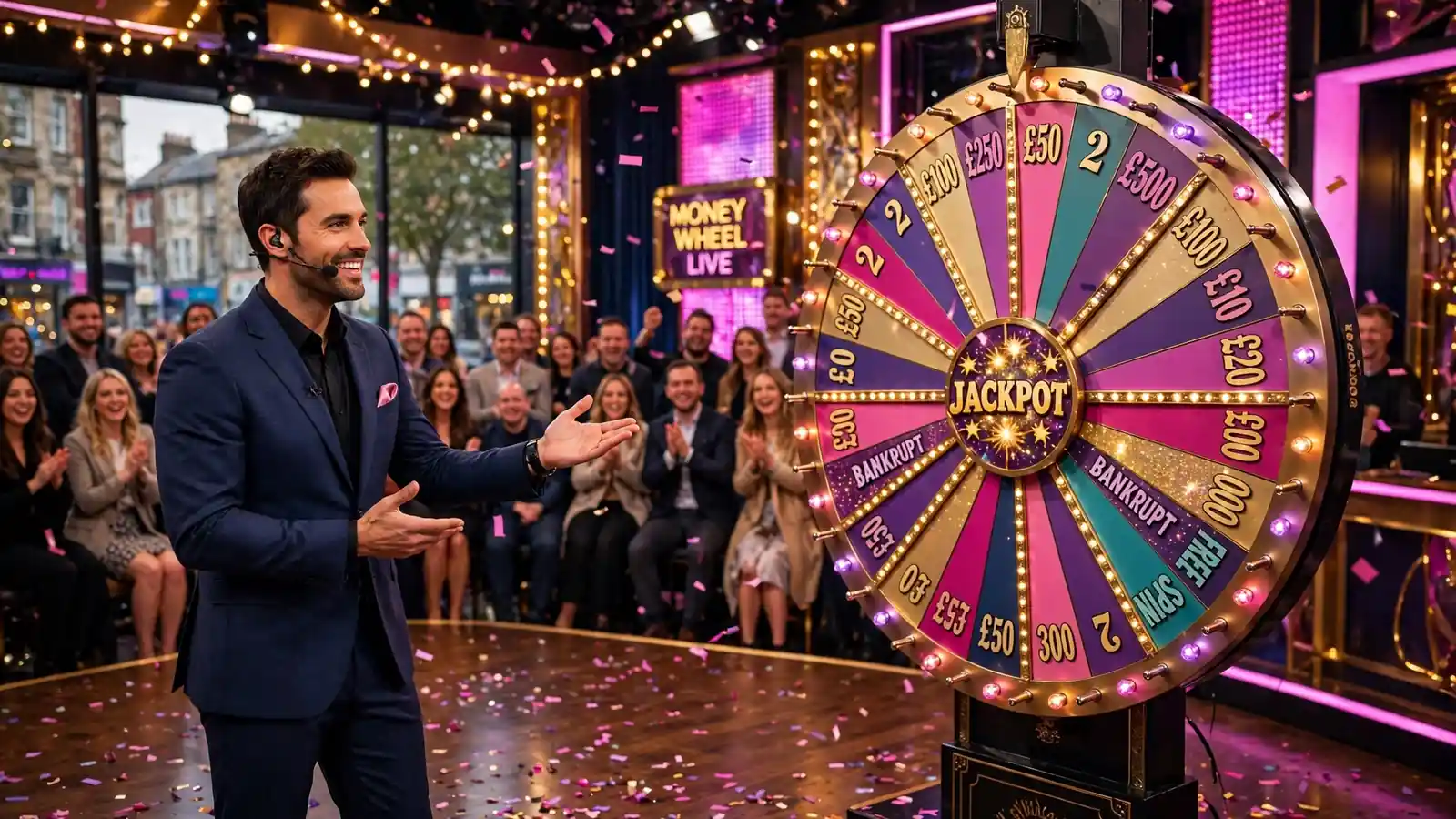
How Crazy Time Fits into Online Live Casino Play
An online live casino combines a video stream with a betting interface. The stream shows gameplay taking place in a studio, where a human dealer manages the live proceedings. The player follows the broadcast on screen and submits bets through controls on the same page or app. This differs from a fully digital casino game, in which software generates the action without a live studio feed.
That distinction matters when considering Crazy Time in an online casino setting. The name may appear among live-casino content, but the general format alone does not establish a particular title’s rules, presentation or available features. Those details belong to the game itself and should not be inferred from the word “live”. What can be described more broadly is the route through which live casino play takes place: a streamed session, an interface for placing bets and a licensed operator providing the service.
For UK players, the legal setting is part of that arrangement. A live dealer casino serving the British market must hold a UK Gambling Commission licence. The licence applies to the operator, not to the video format as an abstract category. A studio broadcast may look similar across different websites, but that does not make the operators interchangeable from a regulatory standpoint. In Britain, online gambling is legal at licensed and regulated sites, with participation restricted to adults aged 18 and over.
When choosing a UK casino for Crazy Time in 2026, payout timing is one practical detail to consider. This list gives the known withdrawal timeframe for each operator.
-
Britsino
- Payout speed
- 1-3 business days
Britsino lists a payout speed of 1–3 business days.
-
Amunbet
- Payout speed
- 1-3 business days
Amunbet lists a payout speed of 1–3 business days.
-
Dieselwin
- Payout speed
- 1-3 business days
Dieselwin lists a payout speed of 1–3 business days.
-
BeOnBet
- Payout speed
- 1-3 business days
BeOnBet lists a payout speed of 1–3 business days.
-
Jetsetspins
- Payout speed
- 1-3 business days
Jetsetspins lists a payout speed of 1–3 business days.
-
SpinFormula
- Payout speed
- 1-3 business days
SpinFormula lists a payout speed of 1–3 business days.
-
Revery Play
- Payout speed
- 1-3 business days
Revery Play lists a payout speed of 1–3 business days.
-
WinBeast
- Payout speed
- 1-3 business days
WinBeast lists a payout speed of 1–3 business days.
-
Chanze
- Payout speed
- 1-3 business days
Chanze lists a payout speed of 1–3 business days.
-
Zombillion
- Payout speed
- 1-3 business days
Zombillion lists a payout speed of 1–3 business days.
The live stream is not simply decorative footage beside a digital game. It shows real-time activity in a studio, with the dealer present and responsible for the on-camera process. The interface remains the means by which a player enters a bet. In practical terms, the screen has two jobs: delivering the broadcast and recording the player’s selection. The displayed action and the betting controls therefore operate together, even though they are not the same thing.
This hybrid arrangement also changes the feel of a session. Live games proceed more slowly than digital versions because the action is being conducted and broadcast rather than resolved entirely by software. The interface may display choices and the current state of play, but it cannot make the studio process instantaneous. A player moving from a rapid digital game to a live table should expect a different rhythm. That is a feature of live delivery, not evidence about the rules of any individual game.
The difference has a financial side as well. Live tables have higher minimum bets than digital versions. That sets a higher entry point for each round, which can affect how long a fixed budget lasts. The relevant comparison is not just whether a game is available, but how the table minimum fits the amount set aside for entertainment. A session with a higher required stake gives less room to make small bets; the stream does not change that arithmetic.
Connection quality is another basic condition. The broadcast and betting interface rely on an internet connection that remains stable. If the stream freezes or the controls stop responding, the experience is interrupted, and uncertainty about what is visible or submitted can become part of the session. Live casino play is consequently less suited to a connection that drops in and out than a game that runs locally on a device. This is a general property of real-time video, not a special rule attached to Crazy Time.
The surrounding website may place live casino games alongside slots and other digital products, but their operating formats are not the same. A digital game can move from one result to another without waiting for a studio to conduct the next stage. A live game follows the pace of the broadcast. That difference affects the time spent in each round and the way the player interacts with the screen. It does not, by itself, reveal the odds, payout structure or quality of a particular title.

Accordingly, “Crazy Time online casino” is best understood as a reference to access through an online casino environment, not as a complete description of the product. The online casino supplies the account and interface through which play is reached; the live format supplies the studio stream and dealer-led action. Each layer answers a different question. The operator’s regulatory status concerns who provides the service, while the game’s own information concerns what happens within a round.
A useful distinction is between what the live-casino category establishes and what it does not. It establishes that the experience involves real-time studio content and bets placed through an on-screen interface. It also implies the slower pace and higher minimums associated with live tables, alongside a need for a steady connection. It does not establish the rules of Crazy Time, whether a particular version is available, or what features an individual operator has enabled. Those are title- and operator-specific matters, not consequences of the general live dealer format.
This section is for entertainment purposes only and is not gambling advice.
The Casino Game Show: What the Live Format Means
A live casino game show combines a streamed, real-time table with betting through an on-screen interface. The pace is set by the live session rather than by a digital game that can move straight from one result to the next. That difference affects how much time a round takes and how quickly decisions can be made. A search for a Crazy Time live casino game show in the UK in 2026 may point towards this format, but the phrase alone does not establish the rules or features of any particular game.
The live format has three practical conditions: play moves more slowly than in digital versions, minimum bets are higher, and the stream depends on a stable internet connection. These are not cosmetic details. They affect how long a session may take, the amount required to participate at a table and whether the experience remains usable when the connection falters.
Pace is part of the cost
A digital game can present a result without waiting for a live table to proceed. In a live session, the dealer and the sequence of play determine the rhythm. The result is a slower cycle. A player may have more time to observe what is happening, but fewer rounds may fit into the same period than in a faster digital format.

That slower pace does not make a session inexpensive by itself. Time and stake are separate parts of the calculation. If each live round takes longer, the session may involve fewer decisions per hour; if the minimum stake is higher, each decision may still commit more money than at a digital alternative. Neither feature establishes what a particular player will spend, since that depends on the chosen stake and how long play continues.
A sensible assessment therefore separates entertainment time from money at risk. A live presentation can make a game feel more like an event, but production and interaction do not change the underlying fact that bets can be lost. A budget set before play is a useful boundary; extending it to recover losses changes the calculation rather than improving it.
Minimums change the entry point
Live tables tend to have higher minimum bets than digital versions. That affects access in a direct way: a table’s minimum determines whether a proposed stake is available at all. It is not enough to compare game names or visual presentation. Table conditions matter, and the minimum shown for a specific session is more relevant than an assumption based on the category.
The distinction is especially important when a casino game show is considered alongside other live dealer options. “Live” describes the delivery format, not one universal price point. Minimums can differ between tables, and no single figure can be applied to every game or venue. A low planned stake may fit a digital version but fail to meet a live table’s entry condition.
Higher minimums also make short sessions less predictable in cost. The minimum is not a forecast of total spend; it is the floor for an individual bet. How often bets are placed and whether they win or lose remain separate variables. Treating the table minimum as a spending cap would be a basic accounting error.
The stream is a condition of play
Live play relies on a stable internet connection because the game is delivered as a real-time stream. The interface and video need to remain sufficiently consistent for the session to be followed. An unstable connection can interrupt viewing or make it harder to keep track of the live sequence. It does not alter the table’s rules, but it can reduce the practical value of choosing a live format.

This dependence differs from the pace of play. A slower table is a feature of the format; a disrupted stream is a technical problem. A connection that works for browsing or short clips may not be a reliable measure of how it will perform during continuous live video. The relevant point is not a promised speed threshold, but the need for a stable connection throughout the session.
The game-show presentation may attract interest because it appears more theatrical than a standard digital casino game. That impression should not be mistaken for evidence about a specific title’s mechanics. The general live conditions explain what participation may involve; they do not confirm particular rounds, bonus features, prize structures or rules for Crazy Time. Those details require the specific game information shown by the operator.
For a UK audience, “Crazy Time casino” and similar descriptions commonly indicate interest in finding a live version, but the practical decision begins with format conditions rather than branding. The session is slower than a digital equivalent, table minimums are higher, and a steady connection is necessary. These conditions shape access and cost; they do not make the outcome predictable. This material is for entertainment purposes only and is not gambling advice.

Finding Crazy Time on Casino Sites
Crazy Time sits within the live-dealer part of an online casino, rather than among games generated entirely by software. A live dealer casino streams a real-time studio feed, with a human dealer on screen and betting handled through the casino’s interface. That distinction matters when identifying what a listing actually offers: a casino may carry many kinds of online content, but only its live-dealer provision has this streamed format.
In the UK, a casino offering live dealer games is legal when it holds a licence from the UK Gambling Commission. The licence is the relevant dividing line between licensed provision for the British market and content presented by an operator outside that regulatory framework. A game name or studio image on a page does not, by itself, establish the status of the casino hosting it.
This is a practical way to assess claims about Crazy Time casino sites in the UK. The operator’s regulatory position and the game’s format are separate questions. A UKGC-licensed casino may offer live dealer content, but that general fact does not establish that every such casino carries Crazy Time. Equally, a page describing a game as “live” does not prove that the service is licensed for UK players. The licence concerns the operator; the live stream describes how the game is presented.

The live format also explains why casino listings can be easy to misread. A casino homepage may place live tables alongside digital games and other promotions, while the actual gameplay appears in a separate studio stream. Bets are still submitted through an on-screen interface, but the round itself is shown as it happens, with a human dealer present. A still image, promotional banner or category label is not the same as evidence of an operating live table.
The term “best Crazy Time casino sites” suggests a comparison, but a defensible comparison needs more than a matching game title. It would require reliable details about the relevant operators and their offerings, assessed on a consistent basis. A site’s general live-casino category cannot settle those points on its own. Nor does a prominent placement establish that an operator is better suited to a particular player; prominence is a design choice, not a financial measure.
The same care applies to references to Crazy Time scores. In a live game, the screen may display information associated with a round or outcome, but the presence of a score display should not be mistaken for evidence that earlier results control later ones. A score label is a feature of presentation, not a basis for predicting a future result. Where a casino page uses score-related language, its meaning depends on what the actual game screen shows, rather than on the wording of a promotional caption.
Bonuses and strategy are also distinct from the question of where a game is available. A casino may advertise an offer across its site without making that offer applicable to every live table. Similarly, a general live-casino label does not establish a particular approach to play. Availability, licensing and the terms of an offer are separate matters; combining them in one headline does not make them interchangeable.
For Crazy Time, the useful starting point is therefore narrow: establish whether the casino is licensed to serve the UK market, then distinguish the live studio presentation from other casino content. That avoids treating a game label, promotional claim or score display as proof of something it does not show. The word “live” describes the format; the operator’s licence establishes whether the provision is within the UK’s regulated market.

Where to Play: Access, Connection and Table Conditions
Access is only one part of the decision to play a live casino game. The practical conditions at the table matter too: live games move more slowly than digital versions, have higher minimum bets and depend on a stable internet connection. These differences affect both the time a session takes and the amount of money needed to take part.
A live stream and betting interface rely on the connection remaining usable throughout play. Interruptions can make it harder to follow what is happening and to place a bet within the available window. A stable connection is therefore a basic requirement, not a performance extra. If the connection is unreliable, the session conditions may not suit live play.
The slower pace also changes how a session feels. Digital games can move quickly from one round to the next; live play includes the timing of the table and dealer. That creates more time between decisions, but it does not make the financial risk smaller. A longer session can still involve repeated stakes, so a budget set in advance should remain the limit rather than a figure adjusted during play.
Minimum bets need checking before a session begins. Live tables generally require more per bet than digital versions, which can make a live option unsuitable where the available budget is small. The relevant amount is the table’s stated minimum, not an assumption based on another game or venue. A minimum is also not a recommended stake: it is simply the entry condition for placing a bet.
For anyone looking to play Crazy Time live in the UK, the same practical test applies before opening a session: confirm that the connection is stable, identify the minimum bet shown for the table, and decide whether that amount fits the preset budget. The name of a game or its wheel does not alter those basic conditions. A familiar title is not evidence that a particular table will suit a particular budget or connection.
Table rules and the paytable should be reviewed before betting. They set out the conditions that determine how stakes are handled, while the minimum indicates the lowest permitted bet. Those are separate pieces of information; neither should be inferred from the other. If the terms are unclear, the financial commitment is unclear too.

A live table is therefore a poor fit when its minimum exceeds the planned stake or when the connection cannot reliably support the session. There is no need to compensate by increasing the budget or extending play. Gambling content is for entertainment only, not financial or gambling advice.
Assessing Casino Options Without a Best-of List
A “best” label has little value without a defined basis for comparison. For a Crazy Time casino in the UK, the first relevant distinction is regulatory: live-dealer casinos may operate legally when they hold a UK Gambling Commission licence. That establishes a licensing condition, not a quality rating or an endorsement of a particular operator.
A ranking would need comparable, current evidence about the casinos being assessed and the specific game listings they provide. Without that evidence, naming a winner would turn an untested impression into a recommendation. No individual operator is ranked here, and no comparative finding is made about which casino is best for Crazy Time.
The licence question can be checked separately from claims about a game. A casino’s UK Gambling Commission status concerns its authority to offer gambling to customers in the market; it does not, by itself, confirm that a particular Crazy Time listing is present, currently available, or offered under identical conditions across venues. Those are separate claims and should not be collapsed into one “best casino” verdict.

The same distinction matters when a casino is described as a place to play a Crazy Time slot. That wording does not, on its own, establish the game’s classification, availability or terms. A casino name beside a game name is not comparative evidence. Nor does an attractive headline show that the underlying offer is better than another venue’s.
A useful assessment therefore has a limited order of operations: establish whether the operator is licensed for the UK market, then confirm the specific listing and its conditions directly with that operator. Any broader comparison requires evidence that is consistent across the options being compared. If one venue has been checked recently and another has not, the resulting ranking is not like-for-like; it is merely more confident than the evidence allows.
This does not produce a list of the best Crazy Time casinos in the UK. It gives a narrower, more defensible result: licensing is a threshold condition, while “best” remains a comparative claim that needs support. A site can meet the threshold without being shown to outperform another, and a ranking cannot be inferred from the licence alone.

Crazy Time casino results are also not a measure of casino quality. A result from a game does not establish that the operator is better, safer or more suitable than another. Those judgments require different evidence. Treating a game outcome as a venue comparison confuses two separate questions.
This page is for entertainment purposes only and is not gambling advice.
Strategy and History: What the Evidence Does Not Establish
A strategy for Crazy Time cannot be derived from general facts about live casino play. The live format explains how a session is delivered: gameplay is streamed from a studio, while bets are placed through an on-screen interface. That describes the setting, not a system for choosing bets or improving the chance of a particular result.
The same distinction applies to claims about a game’s history. A reliable account would need to establish dates, changes and other details specific to Crazy Time. Without those details, a timeline or origin story would be speculation rather than a useful record.
What a strategy can—and cannot—do
A tracker may record past results or organise information, but a record of previous outcomes is not evidence that future outcomes can be predicted. Nor does a sequence in a tracker establish a profitable betting pattern. Treating recorded results as a signal for what comes next turns description into prediction without a sound basis.
General live-casino conditions still matter to a session. Live games move at a slower pace than digital versions, carry higher minimum bets, and depend on a stable internet connection. Those conditions can affect how long a session takes and how much money is committed, but they do not amount to a Crazy Time betting strategy. They provide no basis for claiming that a particular staking pattern, timing choice or tracker improves results.
A controlled budget is a financial boundary, not a way to change an outcome. The same applies to a decision to stop: it limits further exposure but does not recover losses or make a previous result more likely to repeat. Chasing losses or extending a session in pursuit of winnings changes the amount at risk, not the underlying uncertainty.
Reading claims about trackers and history
A tracker’s interface can show the information it records; that alone does not demonstrate that the information has predictive value. Claims that a history chart reveals a winning sequence, or that a particular approach guarantees an advantage, require evidence beyond a display of past results. Without that evidence, the claim should not be treated as a dependable method.
The useful distinction is between information about the live format and information about this particular game. The former supports practical observations about pace, betting through an interface and connection quality. It does not substantiate a detailed Crazy Time strategy, a chronology of the game, or a tracker that can forecast outcomes. Those are separate claims and should be assessed on their own evidence.
Any play remains gambling, not a calculation with a guaranteed return. A budget should be set before play and kept as a firm limit; past outcomes should not be used as a reason to increase it. This discussion is for entertainment purposes only and is not gambling advice.
What a Casino Listing Can—and Cannot—Verify
A casino page can identify a game by name, but that alone does not establish that the game is currently available, that a playable demo is offered, or that the description matches the version accessible to a particular account. A listing is a claim to assess, not proof of every feature implied by its headline.

The same distinction applies to rankings. A page calling a venue a leading Crazy Time casino does not, by that wording alone, show how the ranking was compiled or whether it reflects current availability. A comparison requires evidence about the criteria used and the operators assessed. Without that, a ranked label is presentation, not a measurable result. No particular venue can be confirmed as a top UK choice on the basis of a title alone.
A listing also cannot establish a game’s rules or special features merely by using the game’s name. Those details need to be checked against the information shown for the actual game, including its rules and paytable. Generic casino tips are not a substitute for game-specific rules: advice that assumes a particular feature or betting option may not apply to the version on screen. Past outcomes or tracking statistics do not change the outcome of future play.
For UK real-money play, the legal status of the operator is a separate question from the wording of its game listing. Remote gambling operators serving the British market must hold the relevant UK Gambling Commission licence. A game page does not, by itself, prove that the operator holds one, and a licence does not verify every promotional or game-specific statement made on that page. These are different checks, not interchangeable badges.
A dated label may help establish when a page was reviewed, but it cannot guarantee that a listing remains accurate later. Availability and terms can change; a claim about a demo, ranking or feature should therefore be read in the context of the page that makes it, rather than treated as a permanent property of the game.
The practical distinction is between what is directly visible and what is asserted. A displayed title confirms the wording on the page. Rules and paytables can clarify the game information presented by the operator. Claims about rankings, demo access or special features require their own support. Where those details are not set out clearly, certainty would exceed the evidence.
This content is for entertainment purposes only and is not gambling advice.
Free Play, Demo Access and Real-Money Outcomes
A free-play option and a real-money table are different arrangements. In a practice mode, any balance shown is for play within that mode; it is not cash that can be withdrawn or converted into winnings. A displayed result therefore says nothing about money a player could receive from a paid session.
For Crazy Time, the availability of a free demo or a free-spin offer cannot be assumed from the game’s name appearing on a casino page. A “free” label may refer to a promotion, a practice feature or another condition, so the terms attached to the offer matter. A listing alone does not establish that a playable demo is available, that spins apply to this game or that any promotional balance can be withdrawn.
Free spins and free play should not be treated as interchangeable. Spins may be tied to a promotion, while demo access, where offered, is for practice. Neither should be counted as a cash balance without clear terms stating otherwise. For UK welcome offers, a specialist review has described free spins as commonly applying to slots rather than live tables; that description is not confirmation of a Crazy Time offer. The applicable promotion rules determine which games qualify and how any winnings are treated.

Real-money play changes the calculation: a stake is placed through the casino interface, and the amount at risk is real. A practice result cannot establish what a later paid session will return. Nor does an attractive review or a free-play label establish that a venue is safe. Real-money online gambling in the UK is legal only through operators holding the relevant UK Gambling Commission licence; this is a regulatory condition, not a prediction of outcomes.
Before opting into an offer, its wagering requirements, game weighting and maximum bet limits need to be checked. Live games may count only a small share towards wagering, which can make a headline promotion less useful than its face value suggests. A budget should be set before play and kept separate from promotional balances. Free play can demonstrate an interface if a practice mode exists, but it does not provide real payouts and cannot reduce the financial risk of later betting. This information is for entertainment only, not gambling advice.
GamStop Searches and the Limits of Available Information
A casino described as “not on GamStop” is being identified by its relationship to a self-exclusion programme, not by its permission to serve customers in the UK. Those are separate questions. For a Crazy Time venue offering live dealer gambling to people in Great Britain, the relevant legal test is whether the operator holds a UK Gambling Commission licence. A GamStop label does not answer that question.

The distinction matters because a phrase such as “non-GamStop Crazy Time casino” can cover very different situations. It might refer to a venue that is outside the programme, or simply to a claim made in promotional material. Neither wording, on its own, establishes that the operator is licensed to provide real-money gambling in the UK. The same applies to pages describing an Evolution casino or listing Crazy Time: a game name or provider reference is not evidence of the venue’s regulatory status.
For UK players, online gambling is legal at licensed and regulated sites. Remote operators serving Great Britain must hold the appropriate Gambling Commission licence, regardless of where the operator is based. An offshore location does not remove that requirement when the service is directed at the British market.
GamStop status should therefore not be treated as a substitute for checking the operator’s legal position. A venue’s self-exclusion arrangements and its UK operating licence describe different aspects of its service. Search results and labels may help explain how a site presents itself, but they do not replace the licence requirement.

This distinction is especially relevant where a site promotes access to Crazy Time while also emphasising that it is not on GamStop. That wording may attract attention, but it does not change the regulatory standard for live dealer gambling in the UK. No recommendation follows from the label alone, and it should not be read as confirmation that a venue is suitable or authorised for UK play.
Gambling content is for entertainment purposes only, not financial or gambling advice. A decision to play should not override an existing self-exclusion arrangement or a predetermined spending limit.
Bonuses, Free Spins and Wagering Terms
A Crazy Time casino bonus should be assessed through its terms, not its headline. The key distinction is whether the offer applies to live casino games at all. A specialist review describes UK welcome offers as commonly built around slot free spins, which cannot be used at live tables. That means a free-spin promotion is not automatically a contribution towards play on a live game show.
Where a bonus has wagering requirements, the game weighting determines how much eligible play counts towards meeting them. Live games can carry only a small weighting; a stated weighting of 10%, for instance, means only that share of eligible stakes is credited towards the requirement. It does not mean that the bonus is paid out at that rate, nor does it change the outcome of a game. A low weighting can leave a substantial amount of qualifying play outstanding even when the headline offer looks sizeable.
A deposit promotion and a no-deposit offer also need to be judged by their conditions rather than their names. Relevant terms include which games qualify, the contribution assigned to live casino play, any maximum bet while the offer is active, and the conditions that must be met before a balance can be withdrawn. If a live game is excluded, or contributes little, the advertised value may have limited practical relevance to that game.
Payouts are a separate matter from bonus eligibility. A promotion does not establish what a game will return, and meeting a wagering condition does not guarantee a profit. The cost of the offer is the play required under its rules; the final balance can be higher or lower.
Bonus terms should therefore be checked before opting in, including game weighting, wagering requirements and maximum bet limits. This is entertainment information, not gambling advice.
Casino Games in the UK: Slots, Live Play and More
Content created by the «Apcelero.com» team