Separate BNB payment claims from UK protections
 Available in US
BNB payment availability does not establish UK licensing; the article explains the regulatory boundary and limits of site comparisons.
BNB Casinos and the UK Licensing Divide
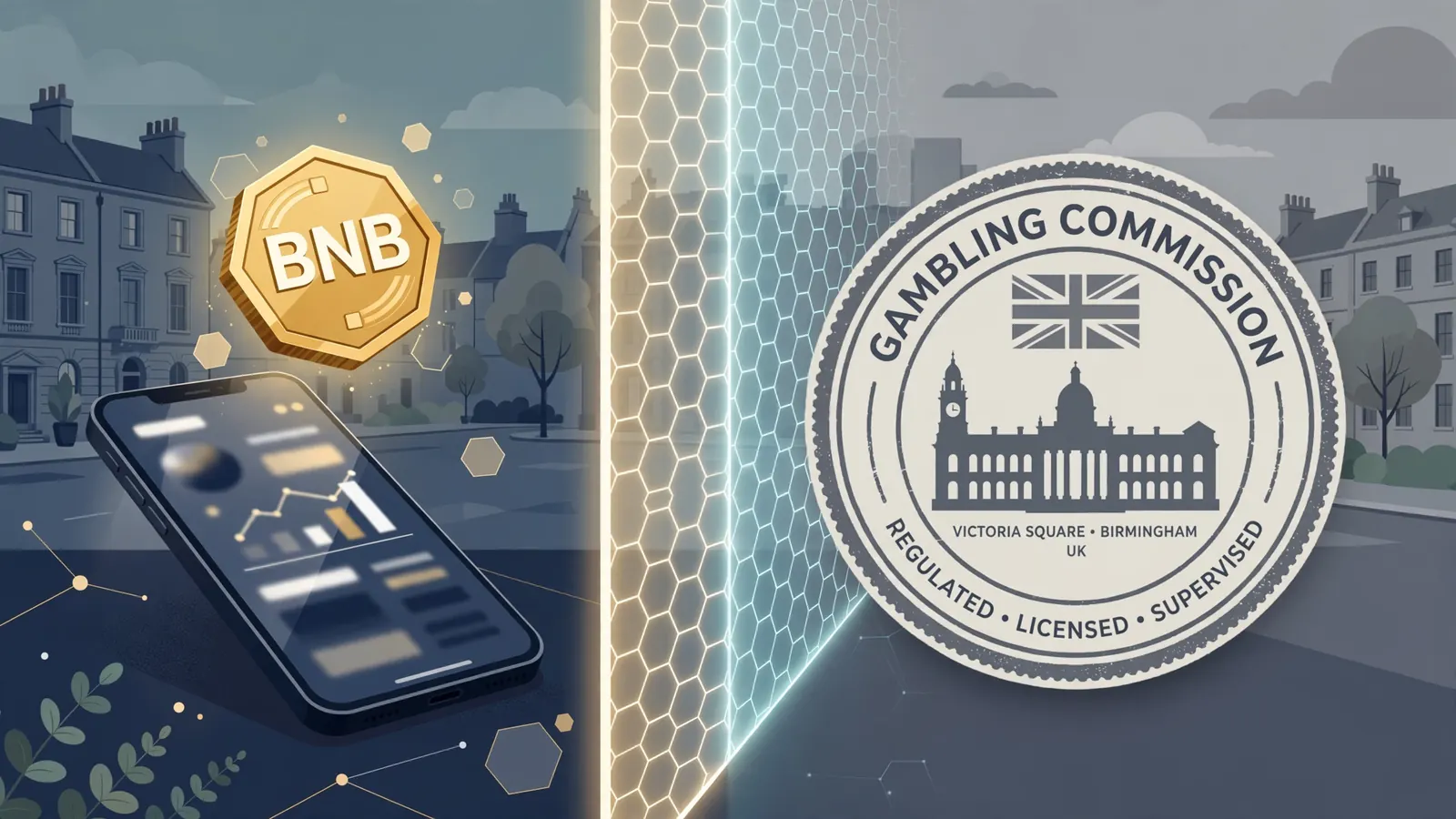
A casino that advertises BNB payments and a casino licensed for the British market belong to different regulatory categories. The distinction is not a matter of branding or the location of a website’s servers. UK-licensed operators are prohibited from accepting cryptocurrency, so BNB cannot be treated as a payment option at a casino operating under a UK Gambling Commission licence.
The UK Gambling Commission regulates commercial gambling in Great Britain, including online casino activity. It is the sole regulator for commercial gambling there. Remote gambling operators offering services to consumers in Great Britain fall within its remit regardless of where their key equipment is located. Moving servers abroad does not, by itself, remove an operator from the British licensing framework.
The Commission issues operating licences to businesses and personal licences to individuals working in relevant roles. For a casino, the operating licence is the important distinction: it is the business authorisation behind a legal online casino serving customers in Great Britain. A site’s use of sterling, its English-language pages or its availability to people in Britain does not substitute for that licence.
When comparing BNB casinos for UK players in 2026, payout speed is one practical detail to check alongside each site's terms. The notes below focus on the payout information available for each operator.
-
Britsino
- Payout speed
- 1-3 business days
Britsino lists a payout speed of 1–3 business days.
-
Amunbet
- Payout speed
- 1-3 business days
Amunbet lists a payout speed of 1–3 business days.
-
Dieselwin
- Payout speed
- 1-3 business days
Dieselwin lists a payout speed of 1–3 business days.
-
BeOnBet
- Payout speed
- 1-3 business days
BeOnBet lists a payout speed of 1–3 business days.
-
Jetsetspins
- Payout speed
- 1-3 business days
Jetsetspins lists a payout speed of 1–3 business days.
-
SpinFormula
- Payout speed
- 1-3 business days
SpinFormula lists a payout speed of 1–3 business days.
-
Revery Play
- Payout speed
- 1-3 business days
Revery Play lists a payout speed of 1–3 business days.
-
WinBeast
- Payout speed
- 1-3 business days
WinBeast lists a payout speed of 1–3 business days.
-
Chanze
- Payout speed
- 1-3 business days
Chanze lists a payout speed of 1–3 business days.
-
Zombillion
- Payout speed
- 1-3 business days
Zombillion lists a payout speed of 1–3 business days.
This creates a clear problem for the phrase “BNB online casino UK”. BNB is a cryptocurrency, and UK-licensed operators cannot accept cryptocurrency. A site that presents BNB as a way to fund casino play should therefore not be understood as a UKGC-licensed casino merely because it is accessible from Britain or uses familiar British wording. The payment claim and the regulatory status are separate matters, and the former cannot establish the latter.
Some offshore casinos may advertise cryptocurrency payments, including BNB. “Offshore” describes a casino operating outside the UKGC system; it does not mean that the operator has a British licence under another name. Nor does an offshore licence become a UKGC licence because the site accepts customers from Britain. The relevant question for the British market is whether the operator holds the required Gambling Commission authorisation.
That distinction matters before comparing payment options or casino features. Search results and promotional pages may group BNB casino sites together by the currency they claim to accept. Such grouping says nothing on its own about whether a site is authorised to offer remote gambling to consumers in Great Britain. “Binance Coin online casino” is a payment description, not a regulatory category.
The same applies to claims about BNB online slots. A slot game and the method used to fund an account are separate parts of a gambling service; neither changes the operator’s licensing obligations. A casino cannot make cryptocurrency acceptance compatible with a UKGC licence simply by limiting BNB to particular games or presenting it as an alternative to conventional payment methods. The prohibition applies to the licensed operator’s acceptance of cryptocurrency.
 Payments at UK Casinos: Deposits and WithdrawalsExplore UK casino payment options, from £1 minimum-deposit searches to cards, e-wallets, bank transfers and cryptocurrencies, with withdrawal topics included.
 Casino Sites That Accept EcoPayz in the UKSee how to check EcoPayz in the live cashier, confirm payment compatibility and understand why availability can vary by account and transaction.
The licensing divide also prevents a common category error: treating “available in the UK” as equivalent to “licensed in the UK”. A website can be technically reachable without being authorised to provide gambling services to British consumers. The Commission’s remit over remote gambling offered in Great Britain is not determined by the physical location of the equipment, so an operator cannot establish compliance merely by pointing to an overseas business address or server.
For anyone considering a BNB online casino, the regulatory status must be assessed independently from the currency label. A site may describe itself as a casino for British players, display prices in pounds or promote Binance Coin deposits; none of those details demonstrates that it holds a UK operating licence. Conversely, a UKGC licence would not make BNB an acceptable deposit method for that licensed operator, because cryptocurrency acceptance is prohibited.
“Best” or “top” BNB online casinos may sound like categories based on quality, but in this context the first distinction is more basic: whether a site is within the British licensing system at all. A list organised around BNB acceptance can include operators outside that system. The wording of a heading cannot bridge the regulatory divide.
The practical classification is therefore narrow. A UK-licensed online casino operates under the Gambling Commission’s authorisation and cannot accept BNB. A casino advertising BNB payments should not be assumed to hold that authorisation. For British consumers, those descriptions do not overlap: the currency claim points away from the UK-licensed category, while the licence determines whether the operator is authorised to serve the market.
What a BNB Casino Comparison Can—and Cannot—Establish
A comparison of Binance Coin casinos can organise claims about sites that advertise BNB, but the label does not establish that any site is authorised to serve people in Great Britain. A payment option and a gambling licence are separate matters. UK-licensed operators are prohibited from accepting cryptocurrency, so a site promoting BNB payments should not be treated as a UK-licensed casino on that basis.
The relevant distinction is not whether a site appears in a comparison, but whether it holds the appropriate UK Gambling Commission operating licence. Remote operators offering gambling to consumers in Great Britain must be licensed by the Commission, regardless of where their equipment or business is based. Online gambling is legal in the UK only through licensed and regulated sites. An offshore casino may be accessible, but that does not place it within the UK regulatory system.
A comparison can help make unlike claims easier to inspect: what a site says about its services, how it describes its licensing, and whether its terms are presented clearly. It cannot turn those statements into regulatory approval. Nor does a shared payment method imply that two casinos offer equivalent oversight, complaint routes or player safeguards. Those conclusions require evidence about the operator’s status, not a common label such as “BNB casino”.
 Bitcoin Cash Casino Comparison UK: Availability and RulesLearn how UK licensing affects BCH deposits, bonuses and privacy; UK Gambling Commission-licensed casinos cannot accept cryptocurrency.
 Casinos That Accept Dogecoin in the UKLearn how Dogecoin payment support differs from slot access and bonus eligibility, and what a deposit listing does and does not confirm.
Licence wording also needs to be read precisely. An offshore licence is not a UKGC licence, and the word “licensed” on a site does not by itself establish permission to serve the British market. A comparison entry is not a substitute for checking the operator’s licence number against the Gambling Commission’s public register before depositing. If the entry does not identify a verifiable UKGC licence, it does not establish that the site is authorised in Great Britain.
The term “BNB casinos UK” can therefore describe sites that are relevant to a UK-based reader without describing UK-licensed casinos. That difference matters: location of the intended audience, availability of a cryptocurrency option and local regulatory status are three distinct claims. A comparison may help separate them, but it cannot make them interchangeable.
The useful outcome is a narrower one. A comparison can present information for examination and identify where claims differ; it cannot certify the truth of every claim, confer a licence, or prove that protections match those of a UKGC-regulated operator. The comparison label is a filing category, not a regulatory credential.
Assessing BNB Casino Sites Without a Ranked List
A site’s claim to accept BNB is only one part of an assessment. It does not establish that deposits are currently available, that withdrawals can be made in the same currency, or that the operator’s terms match the headline description. A useful review separates what the site says from what its published rules and account process actually confirm.
Do
- Identify the specific asset and network on the payment page
- Check published terms for identity check requirements
- Verify the legal entity responsible for the service
Don't
- Assume "crypto accepted" confirms BNB support
- Infer missing payment details from general banners
- Trust a short registration as proof that no later checks occur
The first distinction is between a documented feature and a broad marketing label. “Crypto accepted” does not, by itself, confirm support for BNB. The payment page should identify the asset and network, explain how the deposit is credited, and set out the conditions for a withdrawal. If BNB appears only in a banner or general list of cryptocurrencies, the claim remains incomplete until the relevant payment instructions are clear.
Evidence that can be checked
An assessment should begin with information that can be located and compared, rather than an overall score. Relevant material includes the operator’s published terms, payment rules, account conditions, and a clear statement of the legal entity responsible for the service. These details should be consistent across the site. A discrepancy between a promotional page and the formal terms is not a minor editorial issue: the terms determine the conditions attached to the account.
The wording around BNB also matters. A site may refer to a token, a network, or a third-party payment service without explaining which one applies to the transaction. Those are not interchangeable descriptions. Before treating the facility as usable, the information should identify what the operator accepts and how the payment is handled. Where the explanation is vague, the correct assessment is that the claim has not been established—not that the missing detail can be safely inferred.
 TRON TRX Casino Comparison for UK PlayersLearn why TRON branding does not prove UK authorisation, how the Gambling Commission's remit applies, and which TRX payment claims need checking.
 Casinos That Accept Litecoin in the UK: What to CheckLearn why a general cryptocurrency listing does not confirm Litecoin support, and which account terms and payment details to check before depositing.
The same standard applies to account restrictions. Published rules should explain whether identity checks may be required, what circumstances can delay a transaction, and how the operator handles an account review. A short registration process is not proof that later checks will never occur. The practical question is whether the operator has disclosed the conditions that could affect access to funds, not whether the initial form looks simple.
Separating claims from proof
Reviews and comparison pages can help identify questions, but their labels do not substitute for evidence. A site described as one of the best BNB casino sites may still have unclear terms, incomplete payment instructions, or claims that cannot be checked against its own published material. “Best” is a judgement, not a measurable feature unless the basis for that judgement is stated and applied consistently.
A sound assessment therefore looks for the method behind the verdict. Does the review distinguish BNB support from general cryptocurrency acceptance? Does it explain which documents or operator terms were checked? Does it show whether a statement is the reviewer’s observation, the operator’s own claim, or an independent confirmation? If those categories are blurred, the conclusion carries less weight than its confident wording suggests.
The same caution applies to lists of casinos accepting BNB. A list can show that a site has been mentioned in connection with the currency; it cannot alone confirm that the option remains available, that the account can withdraw in BNB, or that all users receive the same terms. Availability and conditions can change. A dated statement and a traceable source are more useful than an undated badge.
What a comparison can responsibly say
A comparison can organise evidence, but it should not turn gaps into implied advantages. If the information for one operator is clear and another operator’s terms are difficult to locate, that difference is relevant. It does not prove that the first has better service in every respect. Likewise, a polished interface, prominent cryptocurrency branding, or a long list of supported assets does not establish the reliability of the underlying account conditions.
For a BNB deposit casino, the meaningful standard is whether the specific claim is supported by accessible, coherent information. That includes the identity of the contracting operator, the payment instructions, and the conditions that may affect an account or withdrawal. Missing or contradictory details should be recorded as uncertainty, not filled in with assumptions.
Legal status must remain a separate question from a site’s technical features. Remote gambling operators offering services to consumers in Great Britain must hold the relevant Gambling Commission licence, regardless of where their equipment is located. UK-licensed operators are prohibited from accepting cryptocurrency, so a site advertising BNB should not be treated as UK-licensed merely because it uses familiar language or displays a licence claim. Online gambling is legal in the UK only through licensed and regulated sites.
That distinction has practical consequences. An offshore casino does not provide the UKGC regulatory safety net: players do not have UKGC dispute resolution or access to an approved alternative dispute resolution route, and the site is not integrated with GamStop. Offshore players are not breaking the law simply by using such a site, but they are outside those UK protections. A comparison that omits this difference is incomplete, however carefully it describes the payment feature.
 Cardano ADA Casino Comparison for the UKThe UK Gambling Commission's licensing boundary comes before payment claims; learn what remains unverified about operators, ADA payments and KYC.
 Casinos That Accept WebMoney in the UKSeparate WebMoney claims from pay-by-phone availability, bonus rules and alternatives; a review names MrQ, Duelz, Mr Vegas and Videoslots for eligible phone
There is no defensible single winner on the basis of a BNB label alone. The useful outcome is a record of what is documented, what remains unclear, and which protections apply to the operator. That is less dramatic than a ranked verdict, but it keeps the assessment tied to conditions that can actually be checked.
BNB Gambling Sites and Offshore Player Protections
A casino advertising BNB payments may operate outside the UK regulatory system. If it is an offshore casino without a UK Gambling Commission licence, the protections attached to a UK-licensed account do not follow simply because the site is accessible from Britain. The payment method does not create a separate complaints route or bring the operator under UKGC oversight.
That distinction matters after a dispute, not just when an account is opened. A customer of a UK-licensed casino can use the operator’s internal complaints process and, if the matter remains unresolved, access an approved Alternative Dispute Resolution service. An offshore operator is outside that system. Its terms may describe a complaints procedure, but that is not UKGC dispute resolution, and the UKGC cannot provide the same regulatory route for a dispute with an unlicensed offshore business.
The practical consequence is a weaker route to challenge an outcome. A disagreement about a balance, a restricted account or a withdrawal may have to be raised directly with the operator under its own terms. The existence of a contact form or complaints policy does not make that process equivalent to an independent, approved ADR service. Nor does an offshore licence give the operator a UKGC licence: those are separate regulatory arrangements.
GAMSTOP does not cover the offshore account
A casino operating without a UKGC licence is not integrated with GAMSTOP. A person registered with the UK self-exclusion scheme should therefore not assume that an offshore BNB gambling site will block account access on that basis. The site is outside the scheme’s UKGC-linked system, so GAMSTOP registration does not provide the same barrier there.
This is a material difference from a UK-licensed account, where self-exclusion is among the responsible gambling tools operators must provide. An offshore site may describe its own account restrictions, but that does not make them part of GAMSTOP or extend a UK self-exclusion request to the operator. For someone relying on self-exclusion to prevent gambling, an account at an offshore casino can therefore sit outside the protection being used elsewhere.
The same boundary applies to other safeguards associated with UK licensing. UKGC-licensed operators must offer responsible gambling tools and an internal complaints route, with access to approved ADR. An offshore casino does not acquire those obligations by accepting customers in Britain or by presenting a familiar account interface. The customer-facing design may look similar; the regulatory framework is not.
Legal position and practical exposure
The UK does not criminalise an individual for gambling with an offshore operator. That point concerns the player’s personal criminal liability; it does not mean the operator is authorised to offer remote gambling to people in Great Britain. Operators selling into the British market are required to hold the relevant Gambling Commission licence. These are separate questions, and treating them as one obscures the risk: the player is not thereby committing an offence, while the operator remains outside the UKGC system.
 Instant Bank Transfer Casinos in the UK: How They WorkLearn how bank transfers fit a casino cashier, what “instant” can mean, and why deposit and withdrawal routes may differ; availability depends…
 Same-Day Payout Casinos in the UK: How Timing WorksLearn how cashier processing, payment routes, verification and withdrawal limits affect whether funds arrive the same day, not just when a request…
For a person using BNB at an offshore casino, the key exposure is consequently practical rather than a UK criminal penalty. If the operator rejects a complaint, the UKGC dispute route and approved ADR are unavailable. If the person expects GAMSTOP to restrict access, that integration is absent too. The fact that the site accepts a cryptocurrency does not restore either protection.
Before depositing, the licence status is therefore more consequential than the site’s claims about its support channels. A UKGC licence number can be checked against the Commission’s public register. An offshore authorisation is not a substitute for that licence, and an operator’s own account restrictions do not substitute for GAMSTOP. Where a site cannot be treated as UK-licensed, its complaint process and protections should be assessed on that basis rather than assumed to match the UK system.
The distinction also affects how much confidence can reasonably be placed in a promised remedy. A statement that a casino will review a complaint is a statement about the casino’s own process. It is not evidence that an independent UK-approved body can review the outcome. If the issue concerns access to funds or an account decision, the absence of that external route is already part of the cost of choosing the site; it is not a detail that appears only after a complaint is made.
GAMSTOP and Offshore Sites
An offshore BNB gambling site is not integrated with GAMSTOP. Therefore, registration with the UK self-exclusion scheme does not provide a barrier to accessing these accounts.
How to Read Claims About Top BNB Casino Sites
Calling a casino a “top” BNB site is a conclusion, not evidence. The word has no fixed meaning unless the publisher explains what was assessed, how the criteria were weighted and when the assessment was made. Without that information, the label cannot establish that one operator performs better than another.
A ranking can measure different things: whether a site says it accepts BNB, how clearly it explains its terms, or how its service compares against stated criteria. Those are not interchangeable. A site may score well on one measure and poorly on another. A single position in a list compresses those distinctions into a neat order, which is useful for presentation but not necessarily informative for a financial decision.
The method matters more than the adjective. A useful ranking identifies the basis for inclusion and explains how each criterion affects the result. It should distinguish a confirmed feature from an operator’s own claim, and a current assessment from an older one. If the scoring method is hidden, the order cannot be reproduced or checked. If the criteria are vague, a high position means little beyond the publisher’s preference.
The word “best” creates a similar problem. Best for what: payment support, terms, available games, or some other feature? Without a defined purpose, there is no single measurable winner. A page that presents top BNB casinos in the UK should therefore be read as an editorial selection unless its evidence and method support a more precise interpretation. The location phrase does not, by itself, verify a site’s status or suitability for British customers.
 UK Casino Credit Card Payments: What Is AllowedUK-licensed casinos cannot accept credit-card gambling payments; learn how debit cards differ and what to check in cashier payment options.
 Casinos That Accept CashToCode in the UKLearn how to verify CashToCode in an account cashier and check deposit, withdrawal, slot access and payment conditions before paying.
Rankings also have a time dimension. Payment options, terms and operator policies can change. A claim may have been accurate when first published but no longer describe the site. A date of review and a clear account of what was checked help show whether the ranking is current; an undated list leaves that question open.
The same caution applies to star scores and badges. A score is meaningful only when its scale and inputs are explained. A badge may signal an internal editorial judgement rather than an independent certification. Neither should be treated as proof of an outcome or as a substitute for reading the underlying conditions.
For a claim about a top BNB casino to carry weight, the supporting detail must be visible: the criteria, the evidence behind each one, the date of assessment and any limits on the conclusion. If those elements are absent, the ranking is a promotional or editorial statement, not a verified comparison. The word “top” does not supply the missing calculation.
BNB Casino Terms: Bonuses, Wagering and the Final Amount
A welcome bonus is not cash of equal value to its headline. A deposit match adds bonus funds under stated conditions; wagering requirements determine how much qualifying play must take place before any resulting balance can be withdrawn. A maximum cashout can then cap the amount payable, even if the displayed balance is higher.
A specialist review describes welcome offers at cryptocurrency casinos as deposit matches of 100% to 200%, with wagering requirements of 20x to 50x the bonus. Those figures are a report about offers covered by that review, not a dependable description of every BNB casino or a BNB-specific market standard. The applicable offer terms matter more than the headline: whether wagering applies to the bonus alone or to the combined deposit and bonus changes the required turnover substantially.
There is also a conflicting regulatory claim to treat carefully. A specialist review says the Gambling Commission capped bonus wagering at 10x from 19 December 2025. That claim does not align with the higher ranges reported in the same type of review for cryptocurrency-casino promotions. It should not be treated as a blanket rule for every offer, particularly where the operator is not licensed by the Commission. The operator’s written terms and the regulator’s applicable rules are separate questions.
The useful calculation is therefore the amount that can actually leave the account after conditions are met. Check the wagering base, eligible games, expiry conditions and any maximum cashout before assigning a cash value to bonus funds. A low withdrawal cap can make a large-looking bonus economically small; restrictive game eligibility can make the wagering target harder to complete. If the terms do not state how a condition works, its value cannot be reliably calculated.

No-deposit bonuses also need a separate reading. A specialist review reports that they are less common at BCH casinos than at traditional UK sites and, where offered, may combine high wagering with a low maximum cashout. That is not evidence of a BNB-specific offer. BCH and BNB are different assets, so terms reported for one should not be transferred to the other.
For a BNB casino UK offer, the final amount is the withdrawable balance after every stated condition and cap—not the bonus figure shown beside the deposit.
BNB Crypto Casinos and the UK Compliance Boundary
A casino that advertises BNB payments should not be assumed to hold a UK Gambling Commission licence. The relevant distinction is not the coin’s name, network or price; it is whether the operator accepts cryptocurrency at all. UK-licensed operators are prohibited from doing so.
The Commission regulates gambling activity in the United Kingdom, including online casinos. Its licensing framework applies to operators providing gambling to consumers in Great Britain, and a UKGC licence is the requirement for a casino to serve that market legally. Cryptocurrency acceptance therefore sits outside the permitted payment model for a UK-licensed casino.
That makes a BNB payment claim a compliance warning, not evidence of a special arrangement with the regulator. A site may describe itself as available to British customers, display sterling prices or use familiar casino branding. None of those details changes the restriction on licensed operators accepting crypto. The relevant question is whether the operator holds the appropriate UKGC licence and whether its advertised payment method is consistent with that status.
The terms “BNB casino” and “crypto casino accepting BNB” describe a payment feature, not a regulatory category. They do not identify the operator’s licence, establish that the site is authorised to serve British customers or show what legal protections apply. A logo or licensing statement on a casino’s own pages is not a substitute for checking the public register.
This boundary also prevents a misleading comparison between a UK-licensed casino and a site that takes BNB. They cannot be treated as equivalent versions of the same regulated product when the cryptocurrency payment itself is prohibited for UK licensees. A claim that a site is “licensed” needs to be read in context: it may refer to an offshore licence, which is not a UKGC licence.
The distinction is practical. A BNB deposit advertised by an operator does not confirm UK authorisation; it points to a payment arrangement that a UK-licensed casino cannot offer. Licence status and payment claims must therefore be assessed separately, rather than allowing one to stand in for the other.
Casinos Accepting BNB: Deposit and Withdrawal Mechanics
A BNB deposit involves more than copying a wallet address. The asset and network selected in the casino account must match the destination details shown by the operator. A mismatch can leave funds inaccessible or make recovery dependent on the operator; a successful transfer on a blockchain does not by itself mean the casino has credited the balance.
The deposit screen should be checked for the accepted BNB network, any minimum amount, required transaction details and the status used to show receipt. Those are operator-specific conditions, not universal features of BNB payments. A displayed address should be treated as specific to the stated asset and network, rather than reused from an earlier transaction without checking.

A withdrawal follows a separate process. The account balance may need to meet the casino’s withdrawal conditions, and the payout form may ask for a BNB address and network. The amount requested is not necessarily the amount received: any stated processing charge or network fee affects the final transfer. The terms should also make clear whether a withdrawal is reviewed before being sent and how its status is reported.
Blockchain confirmation and operator processing are different stages. A transfer can be recorded on-chain while the casino has not yet credited it; a withdrawal request can remain under operator review before any transaction is broadcast. A transaction hash, where supplied, can help identify a transfer on the relevant blockchain, but it does not settle a dispute about account crediting or fulfilment.
Bitcoin Cash timing figures cannot be used to estimate BNB deposits or cashouts. Confirmation requirements and transfer speed depend on the asset and network, while operator processing adds another variable. BCH-specific claims about confirmation counts or withdrawal times therefore say nothing reliable about a casino accepting BNB.
For UK casinos accepting BNB, the payment page should be read as a set of asset, network, fee and processing conditions—not as a promise that a transfer will be instant or that the amount requested will arrive unchanged. A comparison of those mechanics is meaningful only when the terms identify the exact network and explain the steps from request to completed payment.
BNB Transaction Process
-
1
Deposit Verification
Check the account for the accepted BNB network, minimum amount, and specific destination address.
-
2
Transfer Execution
Send funds ensuring the wallet asset and network match the operator's details to avoid inaccessible funds.
-
3
Withdrawal Request
Submit the payout form with a BNB address and network, noting that processing charges may affect the final amount.
-
4
Final Confirmation
Monitor the transaction hash on the blockchain and wait for the operator to credit the balance.
Casino Games and BNB: What the Evidence Supports
A casino’s claim that it accepts BNB does not establish which games are available to play with it. Payment support and game availability are separate details: a site may describe a cryptocurrency option without explaining whether it applies across the full catalogue, to selected games, or only to the account balance.
That distinction matters when comparing claims about BNB casino games. A game title, provider, or familiar category cannot be inferred from a payment logo or a general statement about cryptocurrency. Nor does the presence of a game on a casino’s website, by itself, establish that BNB can be used in that game. Those are separate claims and require separate, explicit terms.
The same care applies to how play is displayed. A site may show a balance in a cryptocurrency, but that does not establish the denomination used for stakes, the currency in which a game result is calculated, or how any displayed amount relates to a final withdrawal. Without clear terms, those details should not be treated as interchangeable.
For anyone considering whether to play casino games with BNB, the useful evidence is specific: named games, stated availability, and clear rules connecting the game balance to the advertised payment method. General wording such as “crypto games” does not answer those questions. No particular title or provider can be treated as a confirmed BNB option without direct, current information from the operator.
There is also a separate UK boundary. Online gambling offered to consumers in Great Britain requires a UK Gambling Commission licence, while UK-licensed operators are prohibited from accepting cryptocurrency. A BNB payment claim therefore cannot, on its own, establish that a game is legally available through a UK-licensed casino. Game selection and payment support do not resolve the licensing question; they are different parts of the offer.

Depositing BNB to Play Slots: UK Rules and Unverified Details
A cryptocurrency deposit and a slot session are separate questions. A claim that a casino accepts BNB does not establish that it offers slots to UK customers, or that the operator is authorised to do so. Nor does it confirm how a BNB balance would be credited, whether it could be used for slots, or what conditions would apply. Those details should not be inferred from the payment claim.
For online slots in Great Britain, the rules apply to licensed operators regardless of the currency mentioned in a promotion. An operator must verify a customer’s age before allowing a deposit. Customers must be at least 18, and licensed operators must prompt new customers to set a financial limit before their first deposit, with account-level limit controls available.
Stake limits also apply per game cycle. The maximum is £5 for customers aged 25 and over, and £2 for those aged 18 to 24. The £5 limit for adults came into effect on 9 April 2025. A crypto balance does not change those limits: the relevant measure is the permitted stake, not whether the account was funded in pounds or BNB.

Slot sessions have further constraints. Autoplay is banned in Britain, and each online slot spin must last at least 2.5 seconds. These are rules about how the games operate, not assurances about a casino’s payment arrangements or the availability of any particular title.
The practical distinction is material: “deposit with BNB” describes a claimed funding option, while legal slot access depends on the operator holding the required UK Gambling Commission licence and complying with the rules for British customers. No BNB-specific deposit process or slot catalogue can be assumed from the payment wording alone. Any calculation of a playable balance would also require the operator’s actual conversion and account terms; without those, a sterling stake limit cannot be translated into a BNB amount.
Can I legally deposit Bitcoin Cash at UK casinos?
No, not at UK-licensed casinos: they are prohibited from accepting cryptocurrency, and no UK-licensed casino currently accepts Bitcoin Cash directly. A casino offering BCH deposits should not be assumed to hold a UK Gambling Commission licence.
Are Bitcoin Cash casinos safe for UK players?
A BCH casino operating without a UK Gambling Commission licence is outside the British licensing system and is not part of GAMSTOP. Check whether the operator holds the required UK operating licence; accepting BCH does not demonstrate that it does.
How fast are Bitcoin Cash casino withdrawals?
BC.Game and Stake have consistently processed BCH cashouts within 10 minutes of a request, often in under five. Some casinos may queue withdrawals above a threshold for management review.
Is Bitcoin Cash gambling legal in the UK?
The UK does not criminalise individuals for gambling with offshore casinos. However, an offshore BCH casino is not thereby licensed to serve consumers in Great Britain; remote gambling operators serving that market are subject to UK Gambling Commission licensing.
Are Bitcoin Cash casino winnings taxable in the UK?
No. Gambling winnings are not subject to UK income tax or capital gains tax, regardless of whether they are won in GBP or cryptocurrency.
How does funding an account with Bitcoin Cash differ from a standard UK bank transfer?
BCH deposits are made to a casino wallet and typically receive one on-chain confirmation, usually taking about 10 minutes. Transactions are usually cheaper and faster than Bitcoin transactions, but they are recorded on a public blockchain and can often be traced back to a known exchange.
Can I legally gamble with Bitcoin Cash in the UK?
The UK does not criminalise individuals for gambling with offshore casinos. But operators offering remote gambling to consumers in Great Britain must hold a UK Gambling Commission licence, and UK-licensed casinos cannot accept cryptocurrency.
Payments at UK Casinos: Deposits and Withdrawals
Content created by the «Apcelero.com» team